
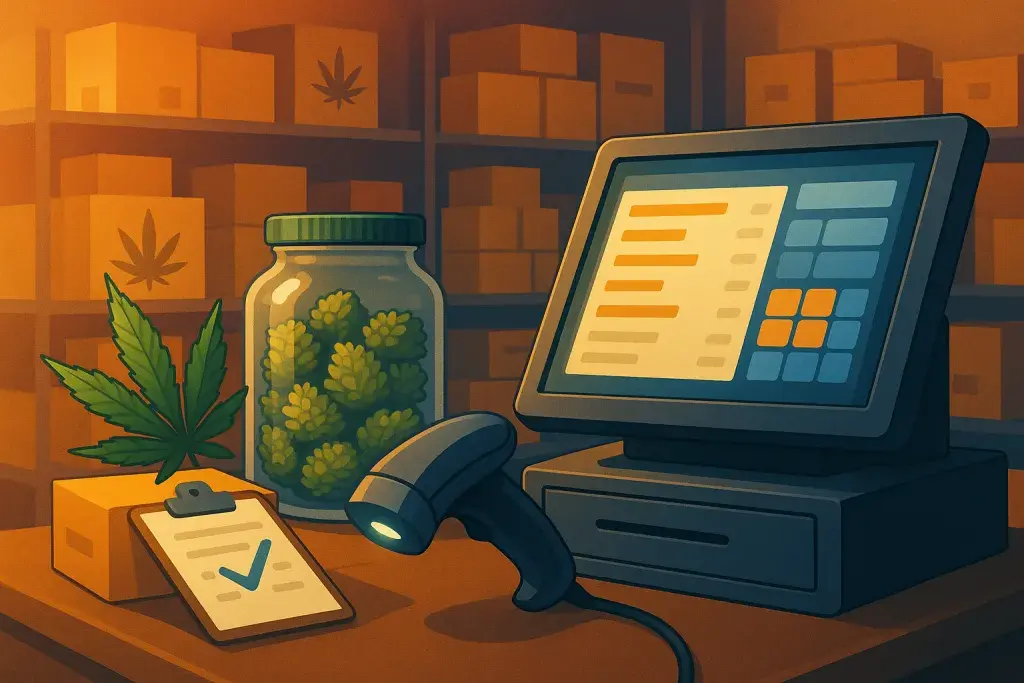
Running a cannabis dispensary is one of the most compliance-heavy retail operations in existence. A single inventory discrepancy can trigger a state audit. A missed reporting window can cost a license. Yet many dispensaries still manage day-to-day operations with tools that were designed for general retail - spreadsheets, legacy point of sale systems, manual tracking logs - none of which were built with cannabis regulations in mind. The gap between what these businesses need and what generic software provides has driven an entire category of specialized technology: cannabis-specific retail software that integrates inventory control, compliance reporting, and customer transactions into a single operational system.
What makes this technology worth understanding goes beyond convenience. The cannabis industry operates under a patchwork of state and local regulations that change frequently, require real-time reporting to government tracking systems, and impose strict audit trails. A well-implemented dispensary software platform does not just process transactions - it functions as a compliance infrastructure layer that reduces human error, automates regulatory reporting, and keeps inventory counts accurate across every shift. For operators scaling from one location to several, or for new dispensary owners trying to build the right tech stack from the start, understanding how these systems work is essential.
This article breaks down the core capabilities of cannabis dispensary POS and marijuana retail software: how each component functions, why it matters operationally, and what to look for when evaluating platforms for your business.
The Foundation: What Cannabis Dispensary POS Systems Actually Do
Beyond Basic Transaction Processing
A cannabis dispensary POS system handles the checkout process, but describing it only as a cash register replacement misses the point. Unlike a typical retail POS, cannabis-specific systems are built around the concept of compliance-by-default - meaning every transaction is logged in a format that meets state reporting requirements without any additional manual steps from the budtender.
When a customer purchases an eighth of flower, the system simultaneously updates inventory, records the transaction against the customer's purchase limit (where applicable), generates a receipt, and pushes a data packet to the state's seed-to-sale tracking platform. These actions happen in seconds, in the background, without requiring staff to do anything beyond completing the sale. That automation is the core value proposition of a purpose-built dispensary point of sale system.
Hardware Integration and Environment Fit
Dispensary environments present specific physical constraints. Customer-facing displays, barcode scanners for product labels, ID scanners for age and identity verification, cash drawers, and receipt printers all need to work together without friction. Cannabis POS hardware is typically configured to handle these touchpoints as a unified setup rather than a collection of loosely connected peripherals.
Many dispensaries also operate in environments with limited or inconsistent internet connectivity - particularly in rural markets or in buildings with poor network infrastructure. Better cannabis POS platforms include offline mode functionality, allowing transactions to be processed locally and synced to the central system once connectivity is restored. This prevents service interruptions during network outages without creating compliance gaps.
Customer Flow and Queue Management
High-volume dispensaries often face a checkout bottleneck that has nothing to do with software - it is the physical flow of customers through the sales floor. Modern dispensary point of sale systems increasingly include integrated queue management tools that allow staff to pre-load a customer's ID verification, product selections, and applicable discounts before the customer reaches the register. By the time the transaction starts, much of the processing work is already complete.
This matters for compliance as much as for customer experience. Rushed budtenders make data entry errors. When software handles the repetitive compliance steps automatically, staff can focus on the customer interaction and accuracy of the transaction itself.
Dispensary Inventory Management: Precision at Every Stage
How Inventory Tracking Works in a Cannabis Context
Dispensary inventory management differs from standard retail inventory in one critical respect: every unit of product has a compliance history that follows it from cultivation or manufacturing all the way to the point of sale. State tracking systems like Metrc, BioTrackTHC, and others require that dispensaries maintain an unbroken chain of custody for all cannabis products on their shelves. This means that when a product arrives from a licensed distributor or cultivator, it comes with a state-issued tracking ID that must be scanned into the dispensary's system and linked to every subsequent action - including sale, destruction, or return.
Good marijuana retail software automates this intake process. When a delivery arrives, staff scan or enter the manifest information, and the system reconciles it against the state's records in real time. Any discrepancy - a missing package, a quantity mismatch - is flagged immediately rather than discovered during an audit weeks later.
Real-Time Stock Visibility
One of the most operationally valuable features of a cannabis-specific inventory system is real-time stock visibility across all product categories. This means managers can see current quantities of every SKU - broken down by weight tier, potency, and batch - at any point during the business day without running a manual count.
Real-time visibility does several practical things. It prevents budtenders from selling products that are not actually available. It enables automatic low-stock alerts, so purchasing decisions are made proactively rather than reactively. For multi-location operators, it provides a consolidated view of inventory across all sites from a single dashboard.
Waste, Spoilage, and Destruction Tracking
Cannabis products have shelf lives, and regulations in most states require that expired, damaged, or unsaleable inventory be destroyed according to specific procedures - with documentation. Dispensary inventory management software handles destruction logs directly within the system, generating records that meet state audit standards without requiring staff to maintain separate paper trails.
The same applies to product returns and recall events. If a product batch is recalled by a manufacturer or flagged by the state, a well-configured system can identify every affected unit across all inventory locations and generate a removal report within minutes.
Vendor and Purchase Order Management
Most dispensary inventory platforms include vendor management tools that allow operators to track relationships with licensed suppliers, log purchase orders, and match incoming deliveries against open orders. This creates a closed loop between purchasing and receiving that reduces the risk of unauthorized products entering inventory and simplifies the reconciliation process at the end of each accounting period.
Cannabis Compliance Software: Staying Aligned With Regulatory Requirements
State Reporting and Seed-to-Sale Integration
Every state with a legal cannabis market maintains a seed-to-sale tracking system designed to monitor the movement of cannabis from cultivation to consumer. Dispensaries are required to report specific transaction and inventory data to these systems - sometimes in real time, sometimes in scheduled batches. Failure to report accurately, or reporting late, can result in fines or license suspension.
Cannabis compliance software handles this reporting through direct API integrations with state tracking platforms. Rather than requiring staff to manually enter data into a government portal after every transaction, the dispensary's POS system pushes the required data automatically. The compliance layer is embedded in the workflow, not bolted on as an afterthought.
Purchase Limit Enforcement
Many states impose daily purchase limits on cannabis consumers - typically defined in terms of total weight, THC milligrams, or product category. Enforcing these limits manually is error-prone, particularly during busy hours. Cannabis compliance software tracks each customer's purchase history and applies limit logic at the point of sale, blocking a transaction that would exceed the legal threshold before it is completed.
This is not just a convenience - it is a legal requirement in many jurisdictions. Selling beyond permitted limits can expose a dispensary to significant regulatory penalties. Automating the enforcement removes the human judgment factor and makes the limit check consistent across every transaction, every shift.
Age Verification and ID Scanning
Every cannabis sale requires identity and age verification. Purpose-built dispensary systems include ID scanning hardware and software that reads driver's licenses, passports, and state ID cards, extracting date of birth and verifying the customer meets the minimum age requirement. The system logs each verification event against the transaction record, creating an audit trail that demonstrates due diligence.
Some platforms also flag expired IDs or flag known fraudulent ID patterns, adding a secondary layer of protection beyond what a human review alone provides.
Audit Trail and Reporting Tools
When regulators conduct an audit, they typically request specific transaction records, inventory logs, and employee activity reports. Cannabis compliance software maintains a complete, timestamped audit trail for every action taken within the system - including price changes, inventory adjustments, voided transactions, and login events. Generating an audit report becomes a matter of selecting a date range rather than reconstructing records from multiple sources.
- Transaction-level logs with employee ID, timestamp, and product detail
- Inventory adjustment records with reason codes and authorizing user
- State reporting submission history with confirmation receipts
- ID verification logs linked to individual sales
- Void and refund records with manager authorization trails
Point of Sale Operations: Speed, Accuracy, and Staff Experience
Budtender Interface Design
The dispensary point of sale interface is where compliance meets customer service. A well-designed interface presents product information clearly, shows real-time inventory, applies promotions automatically, and processes payments quickly - all while guiding the budtender through the compliance steps without making the interaction feel bureaucratic.
Poorly designed interfaces are a genuine operational risk. When a POS screen is cluttered or unintuitive, staff take longer per transaction, make more data entry errors, and create longer wait times for customers. Software designed specifically for dispensary workflows reflects the reality that budtenders are often managing customer conversations and point of sale tasks simultaneously.
Payment Processing in a Cannabis Environment
Cannabis businesses face well-documented limitations in payment processing. Most major card networks do not directly serve cannabis retailers due to federal scheduling, which means many dispensaries operate primarily on cash. Marijuana retail software designed for this environment includes robust cash management tools: drawer management, cash-in and cash-out logging, over/short reporting at end of shift, and safe drop tracking.
Some platforms also integrate with alternative payment solutions - debit card processing through compliant processors, ACH-based payments, or cashless ATM systems - each with their own compliance requirements that the software helps manage. The payment landscape in cannabis is evolving, and dispensary POS platforms that stay current with processing options give operators more flexibility.
Promotions, Loyalty, and Pricing Rules
Managing pricing across a dispensary product catalog requires more nuance than in most retail categories. Prices vary by weight, potency, product type, and customer segment. Dispensaries frequently run time-limited promotions, daily deals, and loyalty programs. Cannabis dispensary POS systems handle this through configurable pricing rules and discount logic that apply automatically at checkout without requiring manual override by the budtender.
Loyalty programs integrated directly into the POS create a closed loop between points accumulation and redemption - no separate app login required, no manual points entry. The customer's history and balance are visible in the same interface the budtender uses for the transaction.
Multi-Location Management and Scalability
Centralized Control Across Locations
Dispensary operators expanding to a second or third location quickly discover that managing separate systems for each site is unsustainable. Marijuana retail software built for multi-location operations provides a central management layer where pricing, promotions, compliance settings, and employee permissions are configured once and pushed to all locations simultaneously.
This eliminates the risk of location-specific pricing errors and ensures that compliance rules are applied consistently regardless of which site a customer visits. It also simplifies staff management - a budtender can be authorized to work across multiple locations within the same system rather than maintaining separate credentials for each.
Consolidated Reporting and Analytics
At the management level, consolidated reporting across locations is one of the most operationally valuable features of enterprise cannabis POS platforms. Rather than reconciling separate reports from each site, operators can view total revenue, product performance, inventory levels, and compliance status across the entire business from a single dashboard.
Analytics tools built into marijuana retail software allow operators to identify which products are moving fastest, which staff members are most productive, which time periods drive peak volume, and where inventory is accumulating without turning. These insights directly inform purchasing decisions, staffing schedules, and promotional strategy.
Inventory Transfers Between Locations
Transferring inventory between licensed dispensary locations requires compliance documentation in most states - a manifest that tracks the products being moved, the originating location, the destination, and the personnel involved. Cannabis compliance software manages this process within the system, generating the required documentation and updating inventory counts at both locations in real time when the transfer is completed.
Choosing the Right Cannabis Retail Software Platform
Core Features to Evaluate
Not all marijuana retail software platforms are equivalent. When evaluating options, dispensary operators should assess a short list of non-negotiable capabilities before comparing secondary features:
- Direct, certified integration with the state's seed-to-sale tracking system
- Real-time inventory tracking tied to the point of sale
- Automatic purchase limit enforcement at checkout
- Complete audit trail with role-based access control
- Reliable offline functionality with automatic sync on reconnect
- Multi-location support if expansion is planned
Any platform that requires manual data export and re-entry into a state compliance system creates an unnecessary risk point. The value of cannabis compliance software is precisely that reporting is automatic and embedded - manual steps defeat the purpose.
Integration With the Broader Tech Stack
A dispensary's software environment typically extends beyond the POS. Accounting software, e-commerce menus, delivery management, and customer communication tools all generate or consume data that the POS touches. Platforms with open APIs or pre-built integrations with common third-party tools reduce the manual reconciliation work that otherwise falls on operations staff.
When evaluating integrations, it is worth asking whether they are bidirectional - does inventory update in real time when an online order is placed, or does staff have to manually sync? Does the accounting integration pull transaction-level detail, or only daily totals? These specifics determine how much operational value the integration actually delivers.
Implementation, Training, and Support
Software quality at the implementation stage determines whether a platform succeeds in practice. Even well-designed systems fail when staff are not trained adequately or when data migration from a previous system is handled carelessly. Operators should ask vendors directly about their implementation process: how long it takes, what data migration support is included, how training is delivered, and what ongoing support looks like after go-live.
For compliance-critical systems, support quality is not a secondary consideration. When a state reporting integration fails during business hours and transactions cannot be logged correctly, the cost of a slow support response is immediate. Vendors who offer live support - not only ticket-based help - provide meaningfully better service for the operational stakes involved in cannabis retail.
Frequently Asked Questions
What is the difference between a cannabis dispensary POS and a standard retail POS?
A cannabis dispensary POS includes compliance-specific features that standard retail systems do not have: integration with state seed-to-sale tracking platforms, automatic purchase limit enforcement, and ID verification logging. These functions are built into the transaction workflow rather than added as plugins, making them far more reliable for meeting regulatory requirements than adapting a generic system.
How does marijuana retail software handle state reporting automatically?
Most cannabis-specific platforms connect to state tracking systems like Metrc or BioTrackTHC via direct API integrations. When a transaction is completed or inventory is adjusted, the system formats and transmits the required data to the state platform in real time or on a defined schedule, without requiring manual re-entry. The operator can view submission logs and confirmation receipts directly within the software.
Can dispensary inventory management software handle multiple product formats - flower, edibles, concentrates - in the same system?
Yes. Purpose-built dispensary inventory management systems are designed to track cannabis products across all categories and formats, each with their own unit of measure, tracking ID requirements, and compliance attributes. The system maintains accurate counts for loose flower sold by weight, pre-packaged edibles sold by unit, and concentrates with specific THC content - simultaneously, within the same inventory environment.
What happens if the internet connection goes down during dispensary hours?
Quality cannabis POS systems include an offline mode that allows transactions to continue processing locally, storing data on the device. When connectivity is restored, the system syncs with the central database and state reporting platform automatically. Operators should verify that offline mode is included and tested before relying on it, as implementation quality varies between vendors.
How does cannabis compliance software enforce purchase limits at the point of sale?
The system tracks each customer's purchase history within the compliance framework - either locally or by querying the state tracking system - and applies the applicable daily or transaction limit to the checkout process. If an item in the cart would push the total above the legal threshold, the system blocks the sale before it is finalized and alerts the budtender. This logic operates automatically and does not require staff to calculate limits manually.
Is it possible to manage promotions and loyalty programs through the dispensary point of sale without a separate tool?
Many cannabis-specific POS platforms include built-in loyalty and promotions engines. This allows operators to configure discount rules, points accumulation, and redemption tiers directly within the system used for transactions. The practical advantage is that promotions apply automatically at checkout and loyalty balances update in real time - no separate login, no manual points entry, and no risk of double-discounting if rules are configured correctly.