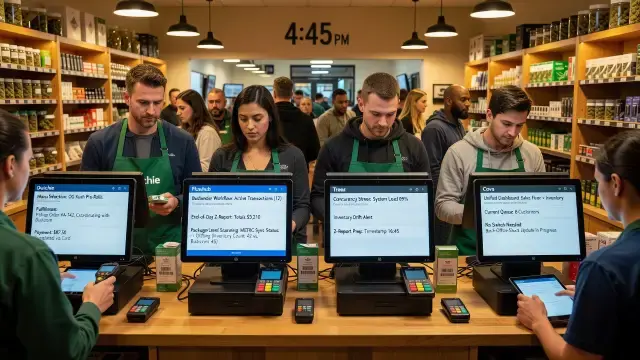
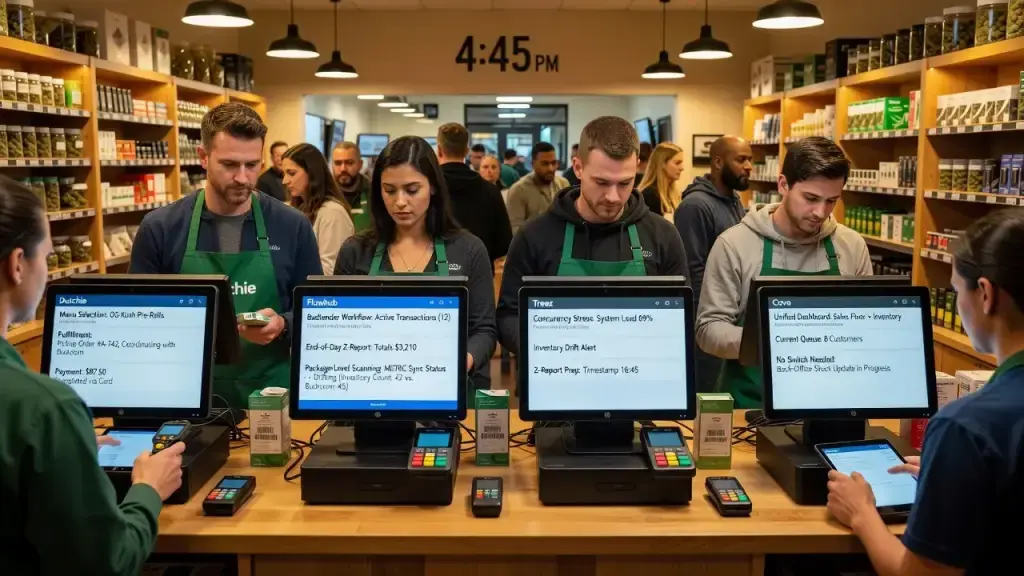
Cannabis retail software gets judged on a slow day in about five minutes. The real test comes at 4:45 on a Friday, when the queue backs up, inventory counts drift from what the budroom actually holds, and a compliance report needs to reconcile against a sale that already happened. A side-by-side look at Dutchie, Flowhub, Treez, and Cova shows how differently these platforms hold up once concurrency - multiple orders, multiple terminals, multiple staff touching the same SKU - stops being theoretical.
Why concurrency exposes the real architecture
Most dispensary software looks fine in a demo. One budtender, one order, one terminal - no contention, no lag, no variance. That's not the environment operators actually run in. A single-location dispensary might have three POS terminals active during a rush, each pulling from the same inventory count, each needing age verification gates to fire correctly, each needing the transaction to land cleanly in a seed-to-sale system like METRC without duplicate or dropped records. Multi-state operators multiply that problem across locations with different state compliance rules layered on top. The platforms that struggle here tend to fail quietly - a package identifier that doesn't update in time, a discount that applies twice, an inventory snapshot that's accurate at open but wrong by close.
Where the four platforms diverge
Dutchie leans into order and fulfillment coordination - menu selection through budtender handoff through payment completion - which suits stores running mixed walk-in and pickup volume. The tradeoff is that compliance and inventory authority often sit with whatever system Dutchie integrates into, so reconciliation workload shifts depending on how that boundary is configured. Flowhub and Treez both center on POS-first daily rhythm: budtender dashboards, end-of-day Z-reports, package and lot-level scanning discipline. Their inventory accuracy is only as good as staff follow-through on scanning and adjustment reasons during receiving and transfers - skip that discipline and the daily reconciliation gets ugly fast. Cova positions itself as a single workflow surface spanning POS and back-office inventory, aiming to cut the context-switching that happens when sales and compliance tracking live in separate tools.
The operational tradeoff nobody avoids
Here's the catch that runs through all four: none of these systems eliminate the need for disciplined staff process. Automated compliance reporting and real-time inventory accuracy both depend on humans scanning correctly, logging adjustment reasons honestly, and following exception-handling procedures instead of taking shortcuts during a rush. Software can reduce the error surface. It can't remove the operator's responsibility for training, tag lifecycle management, and daily variance review.
- Order coordination vs. integration boundary cost - Dutchie's fit depends on what sits upstream for compliance and inventory authority
- POS speed vs. scanning discipline - Flowhub and Treez need consistent package-level data entry to keep traceability clean
- Unified workflow vs. configuration overhead - Cova reduces tool fragmentation but requires process governance to avoid drift
- Multi-location rollouts add coordination cost across all four platforms, not just one
What this means for buyers
Store operators and multi-state operators evaluating this category should stop asking "does it have the feature" and start asking "does it hold under the volume and concurrency we actually run." That means testing age verification gates under simultaneous terminal load, checking how adjustment reasons propagate during transfers, and confirming end-of-day reconciliation actually ties sales totals to inventory variance without manual patching. Payment reliability and compliance reporting are not separate line items - they're the same system under stress. Getting that wrong doesn't just cost time; it creates exposure during an audit, when a state regulator wants package-level traceability that the store can't produce cleanly.