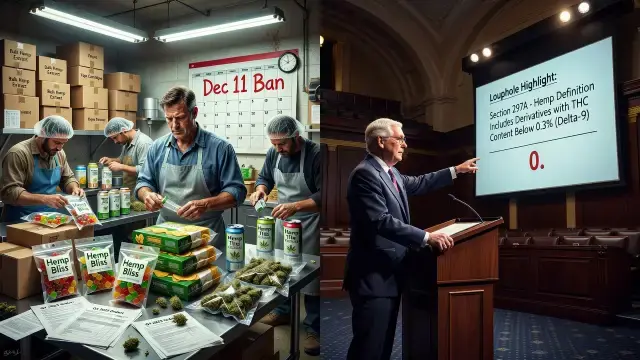
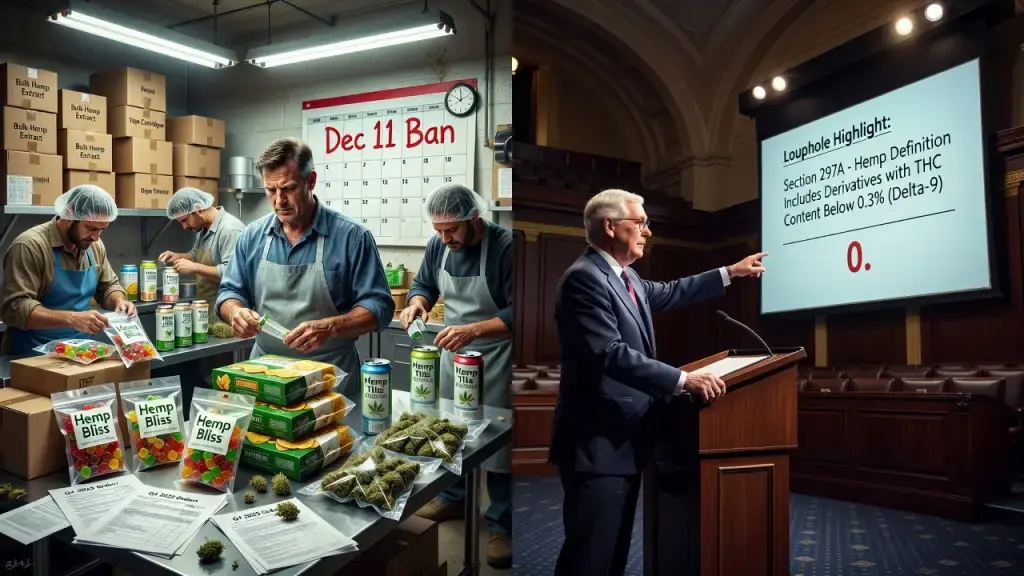
A federal ban on intoxicating hemp products that Congress passed last year was supposed to take effect Nov. 12. It now kicks in Dec. 11 instead, after lawmakers tucked a one-month delay into the short-term funding bill President Trump signed last month. That extra month is the only thing standing between a multibillion-dollar hemp beverage and gummy market and a shutdown that could wipe out thousands of small operators almost overnight.
A Loophole Built Into the Law Itself
The mechanism here matters, because it explains why this fight is so messy. The 2018 farm bill, championed by Senator Mitch McConnell, legalized industrial hemp and defined it by a single threshold: less than 0.3 percent delta-9 THC by weight. That threshold was written with fiber and grain crops in mind, not beverages or gummies. But a drink or edible can stay under that weight-based cap and still deliver a meaningful psychoactive dose, simply by using a bigger serving or a different cannabinoid ratio. That gap is how an entire category of hemp-derived THC seltzers, vapes, chips and smokable flower built a national retail footprint - in vape shops, gas stations, and even some big-box shelves - largely outside the licensing, testing, and tax structure that governs state-licensed marijuana.
Why Licensed Operators Have a Stake in This
For dispensary owners operating under state marijuana programs, this isn't an abstract Washington squabble. Licensed cannabis retailers absorb seed-to-sale tracking costs, mandatory lab testing, COA requirements, compliant packaging rules, and the notorious 280E tax burden that denies standard business deductions to plant-touching companies. Hemp-derived THC products, sold without a cannabis license in many states, have undercut that wholesale pricing structure for years - a convenience-store seltzer competing against a dispensary product that carries a far heavier compliance and excise tax load. Some multi-state operators see the ban as overdue leveling of the playing field. Others worry a blunt federal shutdown, rather than a regulatory framework, could create chaos in a market that dozens of states have already tried to tame through their own hemp rules, age restrictions, or outright bans.
What a December Cliff Looks Like for Small Operators
In practice, a shutdown without transition rules hits small producers hardest. A company like Nicholas Hohns's, running a commercial kitchen outside Raleigh making THC gummies, has inventory on wholesale menus, contracts with retailers, and payroll tied to a product line that could become federally illegal on a single date. There's no graceful wind-down built into a ban like this - no buyback program, no extended sell-through window, just a hard stop. That's a strikingly different posture than how states typically handle licensing changes, where regulators often phase out noncompliant products or give operators time to liquidate batches.
The Regulation-Versus-Prohibition Debate
Industry advocates and some lawmakers argue the smarter fix is regulation, not elimination: age verification at the point of sale, mandatory lab testing, dosage caps, and child-resistant packaging - the same baseline consumer-safety protections licensed marijuana retailers already follow. That would address the real problem, which is unregulated, untested THC products reaching minors through channels with no age-gating, rather than erasing the market entirely. Whether Congress uses the next several weeks to write that framework, or simply lets the ban take hold Dec. 11 as scheduled, remains genuinely unresolved. For dispensary operators, suppliers, and compliance teams watching from the state-licensed side of the industry, the outcome will reshape competitive dynamics, wholesale pricing, and shelf space regardless of which way it breaks.