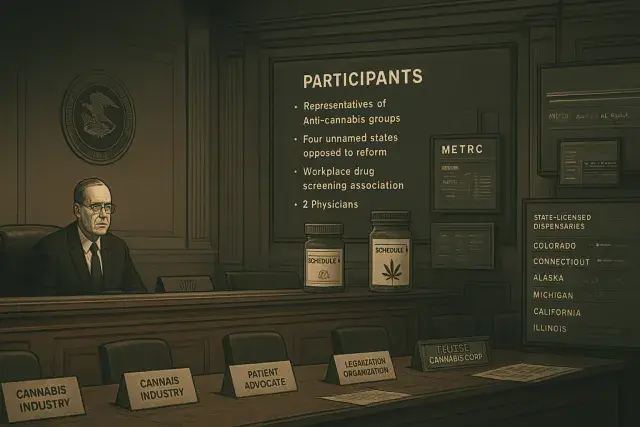
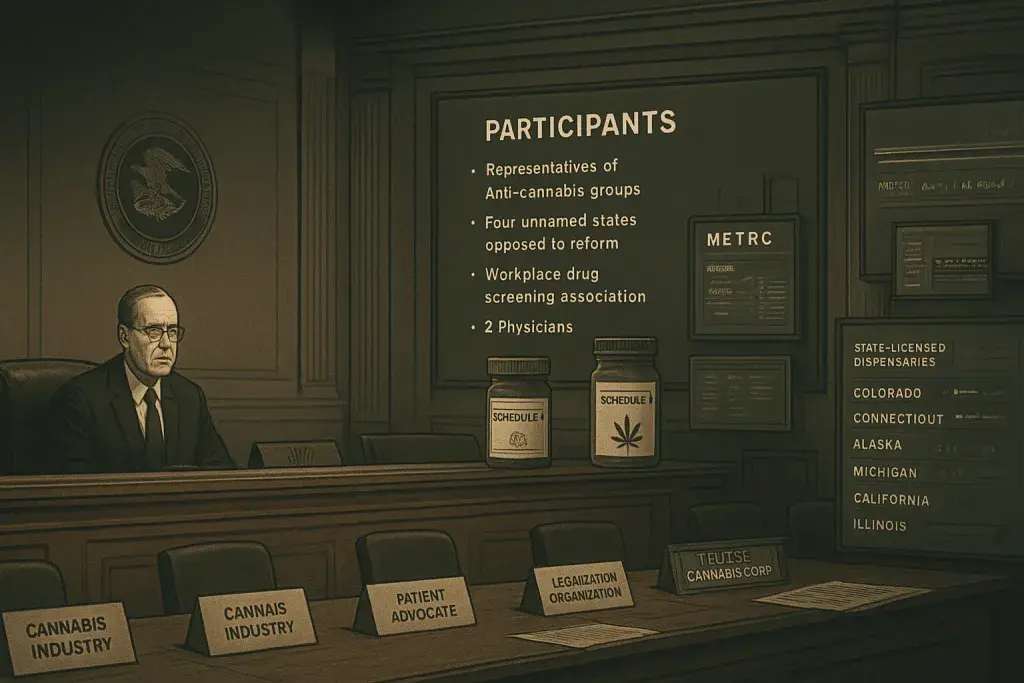
The DEA has released its list of "interested parties" for federal marijuana rescheduling hearings scheduled to begin June 29 - and not a single cannabis industry representative, patient advocate, or legalization organization made the cut. The roster consists entirely of prohibition-aligned voices: anti-cannabis groups, four states opposed to reform, a workplace drug-screening association, and two physicians who have publicly argued against reclassification. For licensed operators watching federal policy from the floor of their dispensaries, this development carries real regulatory weight.
The legal logic behind the exclusion is straightforward, even if it stings. Under the Controlled Substances Act's administrative hearing framework, only parties "adversely affected or aggrieved" by a proposed rule change qualify as interested parties. A trade association that stands to benefit from rescheduling doesn't meet that bar. An operator running a state-licensed medical dispensary in, say, Connecticut or Colorado has no legal standing to complain that the federal government is loosening restrictions on what they sell. That same logic applies whether you're running a multistate operation or tracking cannabis point of sale alaska compliance requirements for a single-location dispensary in a market where federal banking access remains limited and 280E tax exposure still shapes how owners build their P&L. The structure of the law, not DEA bias, is doing most of the work here.
Still, the composition of the participant list raises a pointed question: who defends the Trump administration's own April final rule - the one that already reclassified state-licensed medical cannabis as Schedule 3 - if the hearing's witnesses are uniformly opposed to rescheduling in any form? Some industry observers have noted that the DEA will effectively be left to argue its own position without supporting testimony from the operators, patients, and medical professionals who have the most direct experience with the medical-use profile of cannabis. That's not a technicality. That's a structural gap in an evidentiary proceeding that could influence federal cannabis policy for years.
What the Hearing Actually Covers - and Why the Scope Matters
Here's a detail that deserves more attention than it's getting. The April Federal Register notice confirms the hearing will consider the Biden-era proposal to reclassify all cannabis as Schedule 3 - not just the narrower Trump administration rule that covers state-licensed medical use only. Adult-use cannabis, which drives the majority of licensed retail revenue in states like Colorado, Michigan, California, and Illinois, remains Schedule 1 under current federal law and under the Trump rule. That two-tier structure - medical at Schedule 3, adult-use still at Schedule 1 - creates a fault line that runs directly through multi-license operators, vertically integrated companies, and any brand that sells into both medical and recreational channels.
The 280E tax burden, which for years prevented cannabis businesses from deducting ordinary business expenses because they traffic in a Schedule 1 substance, has already been partially relieved for medical operators following rescheduling. That's real money. Trulieve Cannabis Corp.'s recent listing on the New York Stock Exchange - the first U.S.-based cannabis company to graduate from secondary exchanges to a major exchange - signals what regulatory clarity can do for capital access and investor confidence. But adult-use operators remain in a different legal category, still subject to the full weight of Schedule 1 classification. What the June 29 hearings resolve, or fail to resolve, determines whether that bifurcation hardens into something permanent.
A Shorter List Isn't Necessarily a Slower Road
Some observers who had their applications rejected are reading the participant list with something closer to pragmatism than outrage. The Biden-era hearings that began in January were paused indefinitely after pro-cannabis participants alleged procedural bias - effectively freezing forward movement on rescheduling for months. A leaner roster of participants, even one composed entirely of prohibition-aligned voices, could allow the administrative law judge proceedings to move faster. Fewer parties means fewer motions, fewer scheduling conflicts, and fewer opportunities for procedural challenges to derail the process.
That's cold comfort for trade associations like ATACH, which argued it could have provided the ALJ with medical and scientific testimony in support of reclassification. Fair enough. But the alternative - another round of contested hearings that collapse under their own procedural weight - isn't a better outcome for operators waiting on federal clarity around banking, insurance, payroll processing, and interstate commerce. Speed matters here, even if the journey is uncomfortable.
The Operational Reality Doesn't Wait on Federal Proceedings
Licensed cannabis businesses don't have the luxury of pausing while federal policy catches up. Compliance obligations - state seed-to-sale tracking, METRC integration, lab-tested COAs on every product batch, compliant packaging, age verification at point of sale - run on state timelines regardless of what's happening in a DEA hearing room in Washington. Payroll gets taxed. Rent is due. Wholesale pricing is set against margins that have been compressed by market saturation in mature states. None of that stops.
What federal rescheduling - particularly a broader Schedule 3 classification covering all cannabis - would change is meaningful: easier access to traditional banking, the ability to deduct business expenses across both medical and adult-use operations, potential eligibility for certain federal programs, and a cleaner path to institutional investment. Those aren't abstract policy wins. They're the difference between a business that can build equity and one that's structurally constrained by a classification that predates the entire regulated cannabis market.
The June 29 hearings may not produce the participant list anyone in the industry wanted. But the proceedings are real, the legal stakes are significant, and what the administrative law judge ultimately recommends will land on the desks of people who run dispensaries, manage wholesale accounts, and file tax returns under rules written for a drug war rather than a regulated retail market. Watch this one closely.