Virginia's long-delayed adult-use retail cannabis market has a new target date - July 1, 2027 - after Gov. Abigail Spanberger and Democratic legislators reached a budget compromise following her May veto of standalone legislation. The agreement sets 350 store licenses, a phased rollout, a starting state excise tax of 6%, and a series of small-business and equity protections that lawmakers say are designed to prevent large operators from capturing the market before independent retailers can get established.
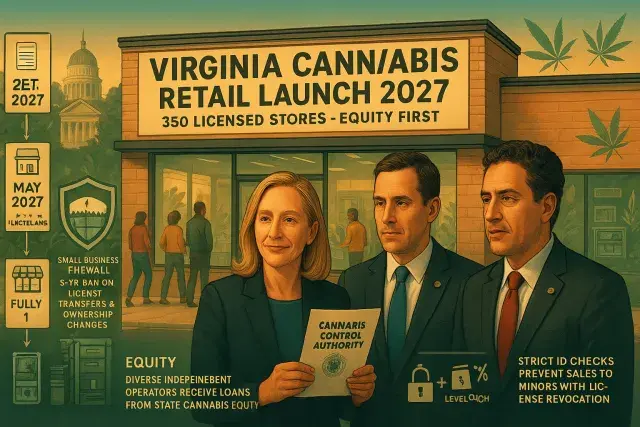
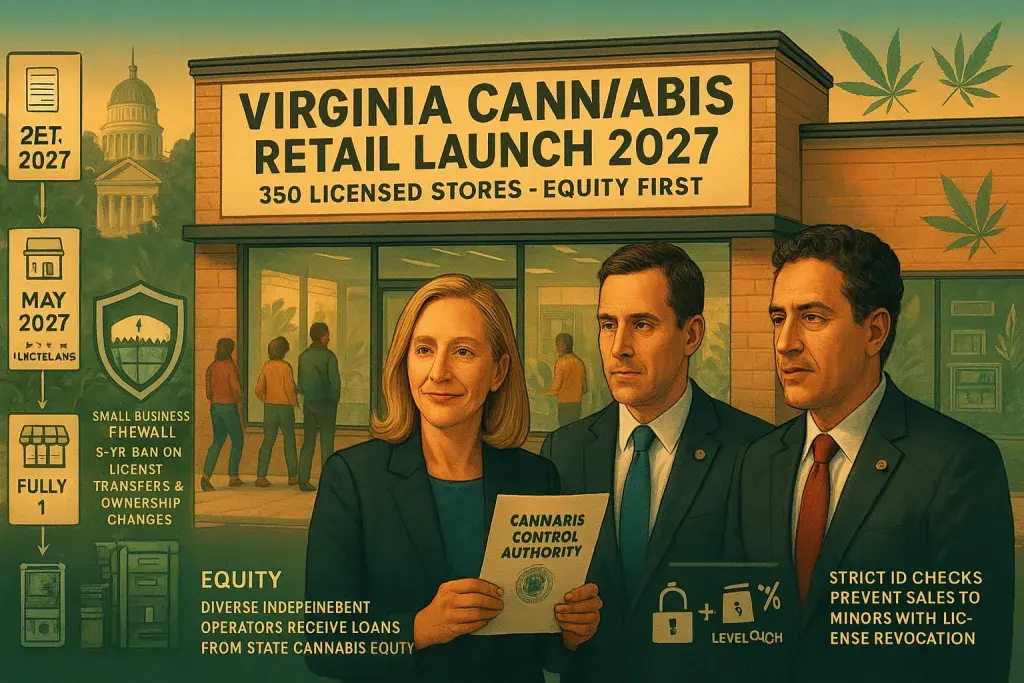
The path here has been anything but clean. Spanberger campaigned on supporting a retail marijuana market, but when the General Assembly sent her legislation this spring without incorporating her amendments - she wanted 200 licenses and a later launch - she vetoed it. The compromise now embedded in the House budget draft threads that needle with a phased licensing approach: the Cannabis Control Authority opens applications February 1, 2027, with up to 100 microbusiness licenses available starting May 1, 2027, and full licensed sales beginning July 1. For operators watching how other regulated markets have built their retail compliance infrastructure - from states with mature frameworks all the way to jurisdictions still working through early-stage rollouts, including tools like cannabis dispensary software alaska that help newer markets manage licensing transitions - Virginia's structured, phased entry is worth tracking closely as a model for balancing competitive access against market stability.
License Structure and the Small-Business Firewall
The 350-license cap was a legislative priority, and it survived the negotiation intact. But here's the catch: not all licenses will be released simultaneously, which matters enormously for how the market takes shape in its first year. Delegate Marcus Simon and Delegate Don Scott weren't the only ones watching that number - multi-state operators with existing footprints in Virginia's medical marijuana program were watching it too.
That's precisely why Delegate Josh Krizek's equity language carries real weight. The compromise prohibits license sales within the first five years of licensing and limits transfers and ownership changes during that window. These aren't cosmetic provisions. Without them, a common playbook in early regulated markets involves issuing equity licenses to qualifying applicants, then structuring management agreements, revenue-sharing arrangements, or partial acquisitions that effectively transfer operational control - and market share - to larger entities. Virginia's wording attempts to close that back door, though enforcement will depend on how the CCA writes and applies its rules, which is always where the details get complicated.
The 75% redirect of first-year license fee deposits to a state cannabis equity business loan fund is a meaningful commitment on paper. Whether it translates into accessible capital for independent operators depends entirely on program design - eligibility criteria, loan terms, application complexity - none of which the legislature has finalized. Krizek acknowledged as much, noting that the 2027 session will work out how that money gets spent. That's a significant detail to leave open, and small-business applicants should track it closely as those rules develop.
Tax Rate Strategy and the Illicit Market Problem
Virginia's 6% state excise tax at launch - capped there until at least July 1, 2029 - reflects a deliberate calculation. Delegate Lashrecse Aird framed it directly as a public safety strategy, not just an economic one: if legal retail can't compete on price with unregulated sellers, consumers won't cross over. That's a real dynamic. States that launched adult-use markets with high combined tax rates have documented illicit market persistence, because compliant products carrying excise tax, lab testing costs, packaging requirements, and licensing overhead simply can't undercut street pricing without policy support.
At 6% state plus up to 3.5% local, Virginia's combined rate at launch could reach 9.5% in localities that impose the maximum. That's still on the lower end for adult-use markets. For operators modeling their pricing and margin structure, the two-year floor on the state rate provides some planning stability - though the path to 8% after July 2029 should be built into any multi-year financial projection. Dispensary operators will also need to account for the fact that 280E, the federal tax provision that disallows standard business deductions for cannabis companies, continues to apply as long as cannabis remains a Schedule I controlled substance under federal law.
Compliance Obligations and the Enforcement Framework
Spanberger's priorities in the compromise show up most clearly on the regulatory side. The CCA gains authority to impose penalties on retailers that fail to check customer identification, with license revocation available for repeated sales to minors. That's an alcohol-style enforcement model, and it's the right framework for a new retail market trying to establish credibility with regulators and the public simultaneously.
The $250 civil penalty for public consumption - delayed until 2027 - was a sticking point for advocacy groups including Virginia NORML, which flagged concerns about how such penalties get applied in practice. Marijuana Justice Executive Director Chelsea Higgs Wise described the compromise as a meaningful step forward while noting that equity implementation will require ongoing scrutiny. Those concerns are reasonable. Civil consumption penalties, depending on enforcement patterns, can land disproportionately on certain communities - a tension that equity licensing provisions alone don't resolve.
The compromise also tightens oversight on intoxicating hemp products sold at convenience stores and gas stations. That channel has been a compliance gray zone in Virginia and across the country, with delta-8 and other hemp-derived cannabinoids occupying retail shelves without the age verification, lab testing, or packaging requirements that licensed dispensaries must meet. Bringing that market under stronger CCA oversight matters for licensed operators who have been competing against unregulated shelf space - and it matters for consumer safety.
What's Still Not Resolved
The most immediate risk to all of this has nothing to do with cannabis. The deal is embedded in a House budget proposal, not a standalone bill - and Virginia's full budget remains unsettled, with the governor, House, and Senate locked in a separate fight over data center tax breaks. Former Delegate Greg Habeeb, now lobbying for the Virginia Cannabis Association, put it plainly: philosophical agreement on cannabis doesn't mean anything if the broader budget falls apart or gets pushed into a conference process that delays the timeline significantly.
For investors, that uncertainty is already registering. Tanner Johnson, CEO of Pure Shenandoah, noted that the May veto cooled investor interest in his planned marijuana operation. Out-of-state firms that specialize in helping cannabis businesses enter new markets are reportedly watching Virginia from the sidelines. That kind of hesitation has real consequences for operators who need capital commitments well before a license application window opens, particularly given the lead time required for real estate, buildout, inventory procurement, and compliance system setup.
If the budget clears and the July 2027 launch holds, Virginia will enter the adult-use market with a framework that at least attempts to balance market access, small-business protection, tax competitiveness, and regulatory enforcement. Whether it executes on any of those is a 2026 and 2027 story. The Joint Commission on Cannabis Transition still has substantial work ahead. Operators, investors, and equity applicants would be wise to stay close to that process - because the rules that get written in the next eighteen months will shape this market for years.