Fort Worth's zoning staff is moving to keep state-licensed medical cannabis pickup locations out of industrial land entirely, instead folding them into the same commercial-district framework that governs ordinary pharmacies. The shift, which surfaced during a city council Infrastructure and Growth Committee meeting, would separate where patients pick up prescribed low-THC products from where those products are actually grown, extracted, tested and packaged.
That distinction matters more than it might sound. Cultivation and processing facilities - the operations handling plant material, extraction equipment and bulk product batches - would be confined to the city's "J" and "K" districts, its medium and heavy industrial zones. Light industrial, or "I" zoning, would be taken off the table for those facilities, largely because those parcels tend to sit closer to residential neighborhoods, including some that council members described as already economically strained.
Why the Industrial-Versus-Commercial Split Matters
Here's the catch: dispensary pickup counters and cultivation facilities are fundamentally different operations with different risk profiles, and zoning codes that lump them together tend to create friction for everyone. A pickup location functions much like a pharmacy counter - patients arrive with a physician's authorization, collect a non-smokeable product such as a tincture, gummy or topical, and leave. There's no on-site cultivation, no extraction equipment, no odor or security footprint comparable to a processing plant. Defining "pharmacy" in the city's zoning ordinance to capture these satellites, as staff proposed, lets them sit in commercial corridors alongside retail pharmacies, medical offices and other low-impact uses.
Cultivation and processing are a different animal entirely - larger footprints, agricultural or industrial-scale equipment, and compliance obligations tied to state seed-to-sale tracking. Keeping those operations in heavier industrial zones, and out of light industrial tracts near housing, is a conventional buffering approach that plenty of municipalities use for everything from food processing to logistics. Council member Deborah Peoples' concern - that placing cultivation sites in light industrial areas near disenfranchised communities would compound existing burdens - reflects a familiar equity argument in cannabis zoning debates nationally, even in a market as tightly restricted as Texas.
What This Means for Licensed Operators
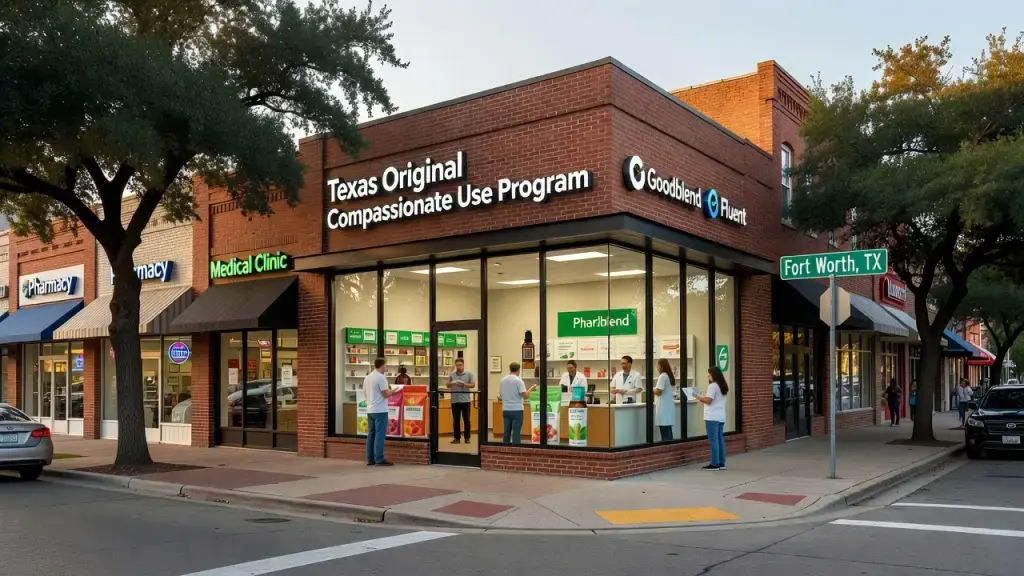
For the three dispensaries currently licensed under the Texas Compassionate Use Program - Texas Original, Goodblend and Fluent - the practical stakes are narrower than they might appear. Texas doesn't permit smokeable flower sales or adult-use retail; these are medical operations selling physician-prescribed, non-intoxicating-by-design products to registered patients. Still, site selection carries real operational weight. A commercial-zoning pathway gives dispensary operators more flexibility in lease negotiations, storefront visibility and proximity to patient populations, compared with being pushed toward industrial parks that landlords and brokers typically price and market differently.
The two existing Fort Worth locations - Texas Original's Horne Street site and Goodblend's Near Southside pickup point - would be grandfathered in regardless of how the final ordinance lands, which removes near-term disruption risk for those operators. But any dispensary eyeing Fort Worth as one of its required satellite locations under the state's public-health-district rule will want clarity on commercial-zoning eligibility before signing a lease. The statewide expansion added 11 public health districts that each dispensary must eventually serve, and the Legislature's licensing of 12 additional operators means more companies are likely scouting Tarrant County real estate even if Fort Worth has no cultivation facilities today.
Compliance and Consumer-Safety Context
None of this changes the underlying regulatory guardrails. Texas Compassionate Use Act products remain non-smokeable, THC-limited, and available only to patients with a qualifying diagnosis and a registered physician's prescription - a narrower framework than adult-use markets elsewhere. Local zoning decisions don't touch state-level testing, labeling or dispensing requirements; they simply determine where a compliant pickup counter or processing facility can physically operate. City officials were direct about that boundary, with planning manager David McCorquodale confirming the changes don't legalize broader marijuana sales "in any shape, form or fashion."
The bigger signal here is preparedness rather than urgency. Fort Worth has no cultivation facilities and no pending applications on file, according to city staff, yet it's building zoning infrastructure now rather than reacting later. For an industry where local land-use rules vary block by block and often lag state licensing timelines, that kind of advance groundwork gives operators, landlords and economic-development groups a clearer map - even in a market where the product itself remains tightly restricted.