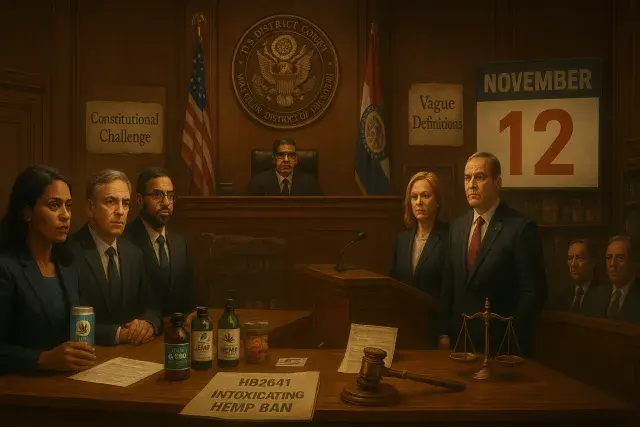
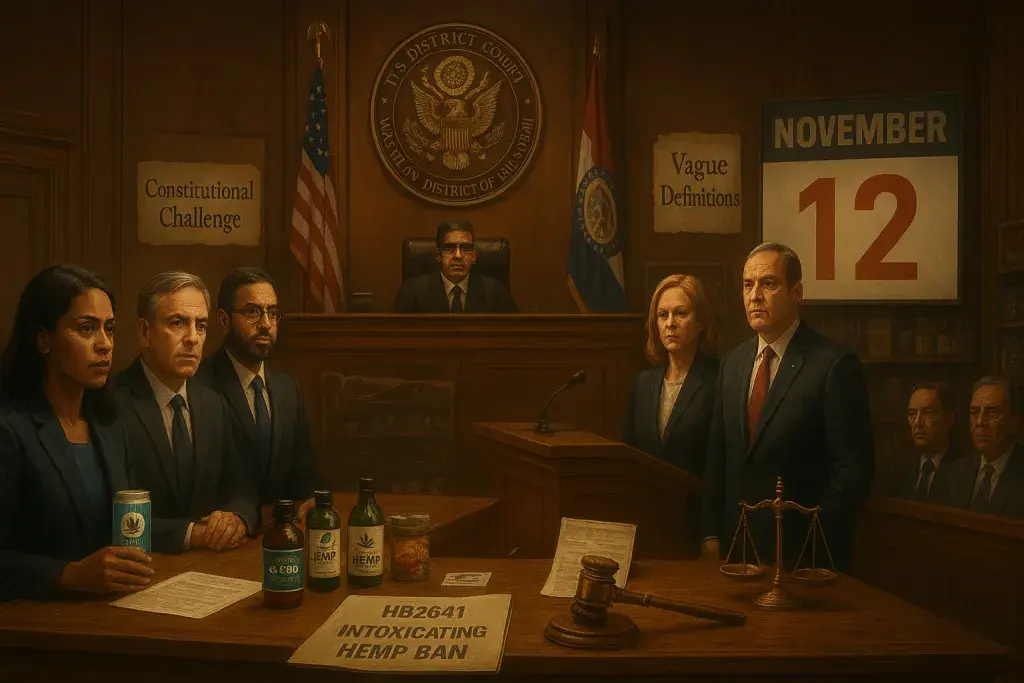
A coalition of Missouri hemp businesses filed a federal lawsuit Thursday seeking to prevent a statewide ban on intoxicating hemp products from taking effect November 12. The suit, filed in the U.S. District Court for the Western District, targets HB2641-a bill signed earlier this year by Gov. Mike Kehoe that would pull THC-infused seltzers, edibles, and other intoxicating hemp items from bars, grocery stores, and smoke shops across the state. The plaintiffs argue the law is constitutionally defective and operationally unworkable.
The coalition includes St. Louis-based MNG 2005, Inc.-parent company of 55 CBD Kratom retail locations nationwide-the Missouri Hemp Trade Association, and Wisconsin-based Lifted Liquids Inc. The core legal argument is not simply that the ban is bad policy; it's that the bill's definitions are so internally contradictory that the same products are simultaneously classified as both "hemp" and "marijuana" depending on which provision you read. That distinction is not a technicality. In states with mature regulatory frameworks-where tools like Colorado seed-to-sale dispensary software help licensed operators track inventory and maintain compliance at the SKU level-the legal boundary between hemp and marijuana is the foundation on which every product approval, distribution agreement, and retail license depends. When that boundary blurs in statute, it doesn't just confuse retailers; it exposes them to criminal liability.
Craig Katz, government relations and compliance manager for MNG, put it plainly: legislators who don't fully understand how hemp is cultivated, extracted, formulated, and tested are poorly positioned to write chemical definitions with criminal consequences attached. That's not a knock on legislators generally-cannabis chemistry is genuinely complex, and the regulatory line between compliant hemp and unlicensed marijuana turns on THC concentration thresholds, cannabinoid ratios, and extraction methods that most general-practice lawmakers haven't had to parse before. HB2641, the coalition argues, is the predictable result.
What the Law Actually Does-and Why Operators Are Alarmed
HB2641 does several things at once, and the combination is what makes it operationally difficult to absorb. First, it bans all intoxicating hemp products starting November 12-affecting not just high-potency products sold in smoke shops, but THC seltzers that have found shelf space in mainstream bars and grocery chains. Second, if Congress reverses the federal hemp ban it approved last year, Missouri would only permit intoxicating hemp products inside licensed marijuana dispensaries. Third, even if Congress delays the federal ban by a couple of years, Missouri would still prohibit everything except intoxicating beverages under state law. Attorney General Catherine Hanaway is tasked with enforcement.
What's striking here is the layered conditionality. Missouri's law essentially attempts to anticipate multiple federal outcomes and prescribe a different regulatory posture for each-while using definitions the plaintiffs say can't support the weight. For any business trying to plan inventory, negotiate wholesale contracts, or structure a compliant distribution model, that kind of statutory architecture is a compliance nightmare. Businesses cannot determine which products are covered or when, the coalition's press release states, which is not a complaint about inconvenience. That's a due process problem.
The coalition also flags a provision restricting who may transport hemp products through Missouri, arguing it effectively interferes with interstate hemp commerce-a federally protected activity. That argument has teeth. Interstate commerce in federally legal hemp has been a point of legal contention in multiple states, and courts have not been uniformly sympathetic to state-level restrictions that function as de facto trade barriers.
The Monopoly Argument-and What It Means for the Licensed Market
Jay Patel, president of the Missouri Hemp Trade Association, framed the legislation in stark terms: not consumer protection, but the elimination of a legal industry and a government-mandated monopoly. That framing is pointed-and not without basis in how the economics would shake out. If intoxicating hemp products can only be sold through licensed marijuana dispensaries, the existing hemp retail channel-smoke shops, CBD stores, grocery outlets-loses an entire product category. Licensed marijuana operators, meanwhile, gain an exclusive on intoxicating THC products across all formats.
Currently, intoxicating hemp products with as much as 1,000 mg of THC are sold in Missouri smoke shops without the testing, packaging, age-verification, and seed-to-sale tracking requirements that licensed dispensaries must meet. There's a real consumer safety argument for bringing those products under a regulated framework. The problem the coalition identifies is that HB2641 doesn't do that carefully-it does it bluntly, in ways that the plaintiffs argue will sweep non-intoxicating CBD products off shelves alongside the high-potency items the bill's sponsor, Rep. Dave Hinman, was clearly targeting.
Hinman, for his part, was direct about his expectations: he believes the lawsuit is unlikely to succeed, and that Missouri will align with federal enforcement after November 12. That may be right. Courts have not always been receptive to industry challenges against state cannabis and hemp regulations, particularly when the state can point to a federal ban as its justification. But the vagueness argument is distinct from a preemption or policy argument-and courts do take statutory vagueness seriously when criminal enforcement is attached.
What Operators and Compliance Teams Should Watch
For businesses with any hemp product exposure in Missouri-whether as a retailer, distributor, or brand-the November 12 date is the immediate pressure point. The lawsuit asks for an injunction to halt the ban while litigation proceeds, but there is no guarantee a court will grant emergency relief on that timeline. Waiting to see how the lawsuit resolves before making inventory or distribution decisions is a high-risk posture.
A few things compliance teams should be tracking closely:
- Whether the court grants a temporary restraining order or preliminary injunction before November 12
- How the Attorney General's office interprets "intoxicating" under the disputed definitions-enforcement guidance, if any is issued, will matter
- Whether Congress moves on the federal hemp ban timeline, which directly triggers different provisions of Missouri's law
- How non-intoxicating CBD product lines are classified under HB2641, given the coalition's concern that the definitions are broad enough to capture compliant products
The broader takeaway for the industry is familiar, even if this instance is particularly tangled: regulatory ambiguity without clear definitions transfers legal and financial risk directly onto operators. When the statute cannot tell a business, a prosecutor, or a judge which products are lawful and which are not, the cost of that uncertainty doesn't fall on the legislature. It falls on the businesses that stocked the shelves.