

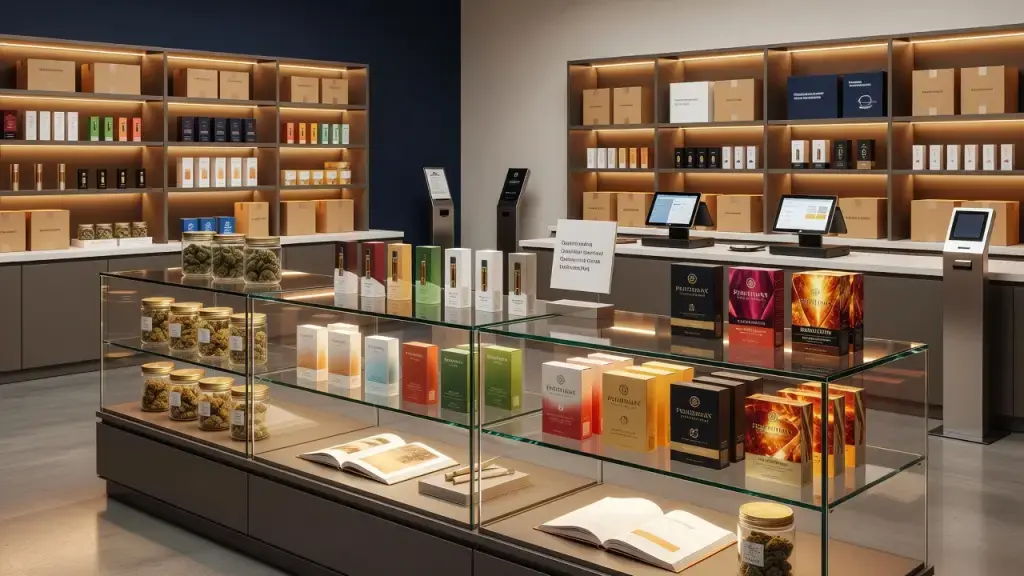
A customer who hunts for the cheapest flower on the menu isn't necessarily the same customer who will balk at a premium vape cartridge. That distinction matters more than ever as discounting becomes the default posture across licensed cannabis retail, and it offers operators a sharper way to think about assortment than the usual budget-to-premium shelf split.
Discounting has become the baseline, not the exception
Cannabis pricing has been sliding for years, and the mechanism isn't a mystery. Overproduction in mature adult-use markets, wholesale oversupply, and competitive pressure from both licensed and illicit channels have pushed average item prices down across most categories. Discount rates have climbed alongside that decline, with promotional pricing now a standard feature of dispensary menus rather than an occasional draw. For operators carrying heavy tax burdens - state excise tax, local cannabis tax, and the federal 280E limitation on standard business deductions - thinner margins per unit make basket size and repeat visits more important than ever.
Here's the catch: a sales report full of discounted transactions doesn't tell you why customers bought what they bought. It shows what moved and at what price, not who was trading down out of necessity and who was buying a familiar product that happened to be on sale. Treating every discounted sale as evidence of price sensitivity flattens a more interesting reality.
Not every purchase carries the same weight for the customer
Mainstream retail data outside cannabis makes the point cleanly. Shoppers who look for promotions and shoppers who splurge on name brands are not mutually exclusive groups - they can be the same person, at the same retailer, in the same week. A customer may fill most of a cart with value options while reserving one category for the product they don't want to compromise on. In cannabis, that could be flower for one customer and a specific edible brand for another. Both look price-conscious on paper. Both have different thresholds for what's replaceable.
That has direct implications for budtender training and menu design. A stated budget from a customer shouldn't automatically trigger a recommendation for the cheapest SKU in the category. Asking what a customer values about their usual purchase - consistency of a particular cultivar, a trusted extraction method, a package format they find easy to dose - gives staff something more useful than a price ceiling. It also helps during a stockout, when a rushed substitution based only on price can lose a customer who would have paid more for the right fit.
What this means for menu structure and margin strategy
Dividing a menu into low, mid, and premium tiers is easy. Explaining what each tier actually buys the customer is harder, and it's the part retailers tend to skip. A premium product needs a specific, defensible reason to cost more - lab-tested potency consistency reflected on the COA, a distinct extraction process, better packaging that meets child-resistant and compliant-packaging standards, or simply a flavor profile customers return for. An entry-level product needs its own clear pitch: quantity, consistency, and an honest comparison to the next price point up. Vague tiering leaves budtenders improvising and customers guessing.
Operators with point-of-sale and seed-to-sale tracking systems already have the raw material to test these assumptions. Transaction history, where data permissions and customer identification allow, can show whether a shopper who regularly buys discounted flower also returns for one specific vape or edible at full price, and whether that pattern holds across multiple visits rather than one outlier purchase. Package size, promotional timing, and product availability all need to be controlled for before drawing conclusions - a smaller package isn't automatically a cheaper-per-gram choice, and a substitution made during a stockout may say nothing about genuine preference.
A compliance and consumer-safety backdrop worth remembering
None of this changes the baseline obligations that govern how cannabis is sold. Age verification, compliant packaging, accurate labeling, and lab testing disclosures remain non-negotiable regardless of where a product sits on the price spectrum. Discount pricing should never come at the expense of clear COA access or dosing information, particularly for edibles and concentrates where potency awareness matters most for new or infrequent customers. Retailers chasing margin through tiered pricing strategies still have to operate within the same regulatory guardrails that govern the rest of the menu.
The broader lesson travels well beyond pricing. Retail margins are tight, tax burdens are real, and discounting isn't going away. But a customer's willingness to save in one category doesn't predict what they'll protect in another - and menus built around that distinction, rather than a flat hierarchy of cheap to expensive, give both the budget-conscious shopper and the brand-loyal one a reason to keep coming back.


