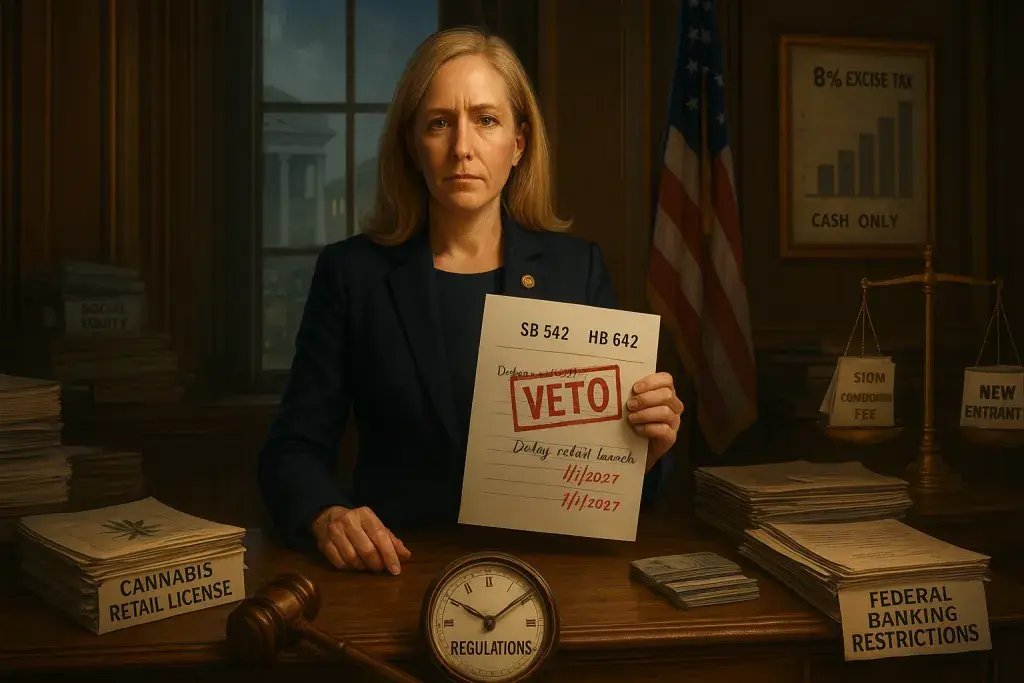
Virginia Gov. Abigail Spanberger is standing behind her veto of the state's adult-use cannabis sales legislation, and she's making a case that operators and would-be licensees should actually listen to - even if they disagree with her conclusion. In a series of interviews following her rejection of SB 542 and HB 642, Spanberger has argued that the bills as passed left too little time to build a functional regulatory framework, created too many licenses too fast, and ignored unresolved federal banking constraints that would have left cannabis businesses operating in a financial gray zone from day one.
The Regulatory Clock Problem She's Actually Describing
Strip away the politics for a moment, and Spanberger is articulating something that anyone who has watched a state cannabis rollout knows to be true: the distance between a signed bill and a functioning licensed market is almost always longer than the calendar suggests. She put it plainly in a recent interview with Cardinal News - "When do you apply for your license? If you are able to open your doors as a store come January, when do you get your license? You walk back from that."
That's not an abstract concern. In state after state, adult-use licensing timelines have slipped because the regulatory agency couldn't staff up fast enough, application portals crashed or were delayed, merit-review processes for social equity applicants took longer than projected, and provisional licenses piled up without corresponding enforcement infrastructure. The result, in more than a few markets, was a combination of supply chain bottlenecks, gray-market persistence, and operators who burned through startup capital waiting on approvals that kept moving.
Under the legislation as passed by Virginia's General Assembly, retail sales would have launched January 1, 2027. Spanberger proposed pushing that to July 1, 2027 - a six-month delay she called necessary to hire regulators, stand up enforcement, and build out the licensing framework. Lawmakers rejected that amendment and the others she proposed, leaving her to sign or veto the original bill. She vetoed it.
License Counts, Market Saturation, and Who Wins
One of the governor's more substantive operational concerns involves what happens when a state issues the full complement of available licenses before anyone has real data on retail demand. "You're basically putting people in a place where if they one day say, I might want to have a retail cannabis shop, like move now or you might miss that chance," she said. "So now they're starting to open a business they know potentially nothing about, without any regulatory framework to dig into, potentially bringing all of their personal capital to bear to try and fund this."
Here's the catch: she's describing something that has happened in actual markets. Cannabis retail has an unusually high cost-of-entry relative to most small businesses - real estate, compliant buildout, point-of-sale systems with seed-to-sale integration, compliant packaging, inventory management software, and cash-heavy operations all add up before a single transaction rings through the register. When states open the market to its full license capacity immediately, operators who are undercapitalized or who overestimated consumer demand can find themselves holding expensive leases and heavy inventory against soft foot traffic. The business risk is real.
Spanberger also flagged the question of whether existing medical cannabis operators - who are already licensed, already operational, and already familiar with Virginia's compliance environment - would disproportionately dominate the adult-use market. The legislation included a $10 million licensing conversion fee for medical operators seeking to enter adult-use retail, which was intended in part to prevent vertical integration from locking out new entrants. But the governor said more structural protection was needed. This is a familiar tension in regulated cannabis markets: incumbent medical operators have capitalized infrastructure and established supply chains; new adult-use applicants, especially social equity licensees, often do not.
Banking, Federal Constraints, and What That Means for Operators on the Ground
The governor also raised the federal banking problem, which doesn't get enough attention in state-level legalization debates. "From a lending perspective at the federal level, there's still real challenges with getting your money in the banking system," she said. That's an understatement for anyone running a cannabis retail operation today.
Cannabis businesses in states where adult-use is legal frequently operate with limited access to traditional commercial banking, payroll services, and small business credit - because federally chartered banks remain cautious about cannabis relationships under current federal law. This forces many dispensaries into cash-heavy operations, which creates compliance headaches, insurance complications, and security costs that non-cannabis retailers don't carry. Payment processing for cannabis retail has improved incrementally, with cashless ATM systems and some fintech providers stepping in, but none of it is the clean merchant services relationship that a conventional retailer has. Virginia operators entering the adult-use market in 2027 or later would be entering into that same environment unless federal law changes in the interim.
Whether that reality justifies a veto rather than a delay amendment is a separate argument. But Spanberger is correct that it's an unresolved operational constraint that new licensees will have to plan around from the start.
What Comes Next - and What Operators Should Watch
The bill is dead, at least in its current form. But top lawmakers aren't treating this as settled. Senate Majority Leader Scott Surovell has said publicly that cannabis retail legalization isn't "totally dead yet for this year," with a budget reconvening scheduled for this month and a July 1 deadline creating pressure on all sides. The idea of folding cannabis provisions into the budget legislation - effectively forcing the governor's hand - is in the air, even if Spanberger has called that possibility "kind of outrageous."
For cannabis businesses and investors with their eye on Virginia, the practical implications are: don't build a Virginia launch strategy around a 2027 date. Not yet. The most likely scenario is that the market doesn't open until a revised bill passes with parameters the governor can accept - or until a budget maneuver forces the issue, which carries its own uncertainty about how any resulting framework gets implemented.
What the governor says she would sign matters here. Her amendments included an 8 percent excise tax kicking in by 2029 (up from the legislature's 6 percent), a six-month delayed launch, criminal penalties for public use and underage possession, and elimination of direct funding for the Cannabis Equity Reinvestment Fund in favor of general fund earmarks. Those are meaningful differences for operators modeling tax exposure, for social equity applicants counting on reinvestment fund access, and for compliance teams trying to plan training around public-consumption enforcement rules.
Virginia's adult-use market will open. The political will is there on both sides, bipartisan polling supports it, and possession has been legal since 2021. The question is under what conditions it opens - and whether the final framework is built for operator viability and equitable access, or patched together under deadline pressure. That distinction will shape the market for years.