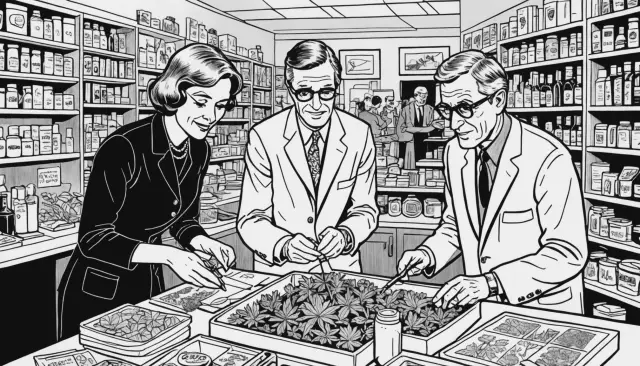
Michigan's cannabis industry has spent years diagnosing an oversupply problem - too much flower, too many licenses, prices collapsing toward the floor. But new consumption data suggests the state's retailers may be overlooking a demand-side fix that's been sitting in plain view: older adults, and Baby Boomers in particular, who appear to be consuming cannabis at rates that would have seemed unlikely a decade ago.
National survey data compiled by the University of Michigan's Monitoring the Future project, and highlighted by NORML, found that nearly 22 percent of Americans ages 55 to 65 used cannabis in the past year - the highest share the survey has ever recorded. Layer that against Headset's generational spending breakdowns, which put Baby Boomers at roughly 12.6 percent of tracked U.S. cannabis purchases, and you start to see a customer segment that dispensary operators have largely built their retail experience around ignoring. That matters operationally, too: as older consumers walk into stores less familiar with modern dispensary layouts, digital menus and checkout flows, the retail technology stack - including point of sale marijuana oregon systems and similar platforms used across state markets - becomes part of how comfortable, or intimidated, a first-time senior customer feels. point of sale marijuana oregon
What the Numbers Suggest for Michigan and Ohio
Applying that 12.6 percent national spending share to Michigan's roughly $3.17 billion in 2025 sales produces a rough estimate of $399 million in annual Baby Boomer cannabis purchases - a MITechNews calculation, not a state-reported figure, since Michigan's Cannabis Regulatory Agency doesn't break out sales by generation. Ohio, still in its first full year of adult-use sales exceeding $836 million, would add roughly another $105 million under the same math. Combined, that's a rough half-billion-dollar regional market hiding inside existing sales data.
Separate survey work backs up the scale of this. The University of Michigan's National Poll on Healthy Aging found 27 percent of Michigan residents 50 and older used THC products in the past year, well above the 21 percent national figure for that age group. Seventeen percent used cannabis monthly, and 9 percent reported daily or near-daily use. That's not a niche segment. That's a real customer base already inside the store.
Why Older Customers Need a Different Retail Approach
Here's the catch: selling to Boomers isn't the same playbook that worked for Millennials and Gen X. Among cannabis consumers 50 and older, the healthy aging poll found 81 percent used cannabis to relax, 68 percent for sleep, and 63 percent for pain relief - motivations that point toward lower-dose edibles, tinctures, topicals and balanced THC-CBD ratios rather than high-potency flower or concentrates chasing maximum THC percentage on the COA.
That has real implications for SKU management and budroom inventory planning. A dispensary built around competitive wholesale pricing and high-THC flower for younger, price-sensitive shoppers may need an entirely different product mix and a differently trained budtender staff to serve someone returning to cannabis after three decades away. Education, not just price, becomes the differentiator - particularly in a market like Michigan's, where ounce prices below $60 have made price competition nearly impossible to win on alone.
Compliance and Consumer Safety Considerations
Any retail strategy targeting older consumers has to be built around consumer safety, not just sales volume. The same University of Michigan poll found 83 percent of Michigan adults 50 and older agree today's cannabis is stronger than what was available decades ago - a meaningful concern given that older consumers are more likely to take prescription medications with potential interaction risks.
- Twenty-one percent of Michigan cannabis consumers 50 and older reported driving within two hours of use at least once in the past year.
- Only 64 percent of monthly consumers said they'd discussed cannabis use with a health care provider - meaning more than a third had not.
- Dispensaries marketing to this demographic must avoid unsupported medical claims tied to sleep, pain or mood, staying within compliant packaging and advertising rules.
None of this solves Michigan's oversupply problem outright, and it won't erase the pressure from the state's 24 percent wholesale tax or the margin squeeze operators are already navigating. But it does challenge the assumption that Michigan and Ohio have already found every customer they're going to get. The data says otherwise - and for operators willing to rethink product mix, staff training and in-store education, the next reliable customer segment may not be the 25-year-old the industry has spent a decade chasing.