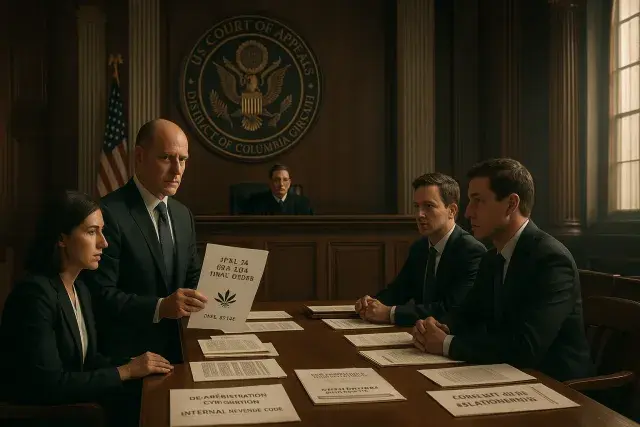
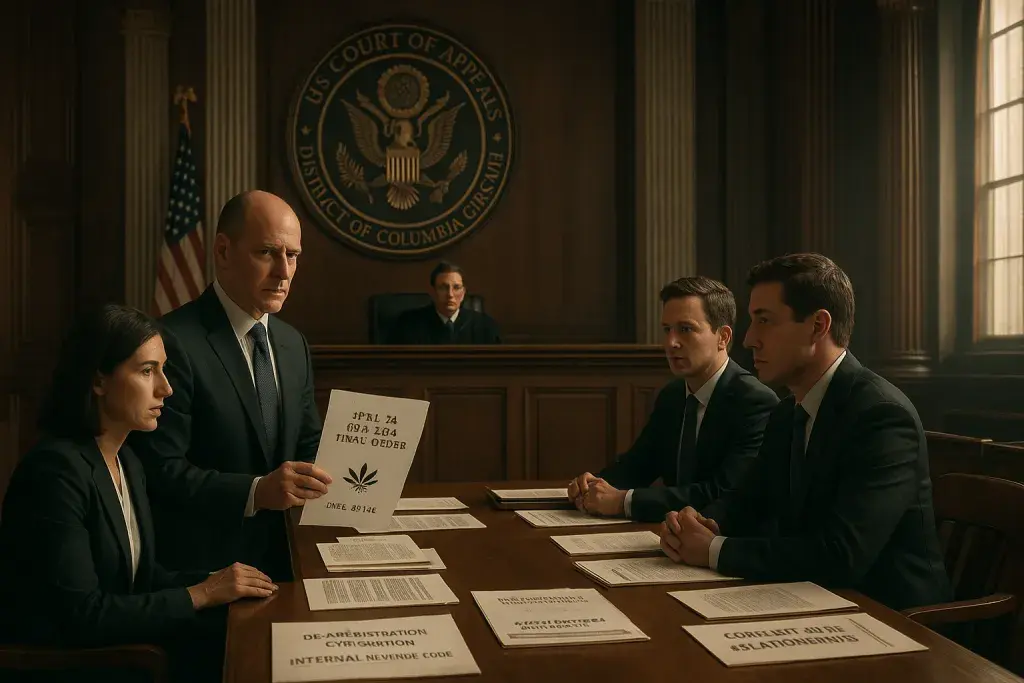
Two state-licensed medical cannabis operators have moved to join the federal rescheduling litigation pending before the U.S. Court of Appeals for the D.C. Circuit - and their arrival has triggered a secondary dispute that could complicate the proceedings. MMJ International Holdings, Inc., one of the existing petitioners challenging DOJ's April 28, 2026 Final Order on marijuana scheduling, says it is reviewing whether the law firm representing the proposed intervenors previously conducted a conflicts check and circulated a draft engagement letter in connection with MMJ's own federal regulatory matters.
The proposed intervenors - MedPharm Iowa, LLC d/b/a Bud & Mary's and Tri-Mountain Pure, LLC - filed their motion on June 29, 2026, seeking to enter the case as party respondents in support of the Department of Justice. Their stated interests run the full spectrum of near-term business planning: pending DEA registration applications under the Final Order's expedited process, relief from Internal Revenue Code Section 280E, commercial relationships, research opportunities, and workforce recruitment. Those are real, concrete stakes. Any operator who has spent years absorbing the full tax burden imposed by 280E - which disallows standard business deductions for companies trafficking in Schedule I or II controlled substances - understands exactly what rescheduling to Schedule III could mean for the bottom line. For dispensary operators in states with robust medical programs, and for compliance-focused licensees tracking regulatory shifts the way a Maine seed-to-sale dispensary software platform tracks inventory movements, the Final Order represents a potential structural shift in federal cost exposure that would reshape financial modeling almost immediately.
The more immediately contentious issue, though, is the professional responsibility question MMJ has raised regarding Blank Rome LLP, the firm representing the proposed intervenors. MMJ says that in January 2026, attorney Shane Pennington of Blank Rome was involved in communications with MMJ that included a formal conflicts review by the firm and the circulation of a draft engagement letter - all following disclosures MMJ made about its own federal regulatory activities. Now that same attorney and firm are representing parties who seek to intervene in support of the government in litigation that directly involves MMJ and related entities. MMJ has been careful to say no conclusions have been reached and that it is reviewing the applicable professional responsibility rules and case law before deciding whether to bring the matter before the Court.
What the Intervenors Are Actually Arguing - and Why It Matters
The intervention motion is, at its core, an economic argument dressed in procedural clothing. The proposed intervenors are telling the D.C. Circuit: if you vacate or stay this Final Order, we lose something tangible. That framing is significant. Courts evaluating intervention motions typically require a showing of legally protectable interest and a risk of practical impairment if the applicant is excluded. By pointing to pending DEA registrations, 280E relief, and business plans built around the Final Order's continued existence, the intervenors are doing exactly what the procedural standard demands.
MMJ's president and CEO, Duane Boise, acknowledged the legitimacy of those interests while making clear MMJ's strategic purpose: ensuring the Court has a complete record. That is a measured position. It signals that MMJ is not disputing the intervenors' right to assert business interests - it is asserting that those interests should be fully visible, and apparently that the manner in which they are being represented should be, too.
The 280E Dimension - A Real Pressure Point for Licensed Operators
For any licensed cannabis business following this litigation, the 280E stakes deserve direct attention. Section 280E of the Internal Revenue Code has functioned as one of the most significant financial constraints on state-legal cannabis operators since courts confirmed its application to the industry. Because cannabis remains a Schedule I controlled substance under the Controlled Substances Act, businesses primarily engaged in trafficking it cannot deduct ordinary and necessary business expenses - payroll, rent, marketing, compliance costs - that any other retail operation would deduct as a matter of course. The effective tax burden this creates can be severe, particularly for single-store operators with tight margins.
Rescheduling to Schedule III would not automatically eliminate 280E exposure - the statute refers to Schedule I and II substances specifically - but the argument that rescheduling removes cannabis from 280E's scope has been widely discussed in cannabis tax and legal circles. That is precisely why the proposed intervenors listed it among their protectable interests. If the Final Order is vacated, that potential relief disappears. For multi-state operators and smaller licensed businesses alike, that is not an abstract legal point. It is a line item.
What Operators Should Watch Going Forward
The intervention motion does not change MMJ's underlying position in the consolidated appeals. MMJ continues to argue that federal regulatory standards should apply uniformly across the marijuana industry, and that cannabis-based medicines intended for patients should meet FDA scientific, manufacturing, and clinical standards - not simply benefit from a rescheduling order that reduces regulatory friction without imposing equivalent safeguards.
The professional responsibility question is a separate track entirely, and MMJ has been explicit that it has not yet determined whether to raise it with the Court. That restraint is notable. Conflict-of-interest motions in complex federal litigation can become collateral battles that consume significant resources and attention - sometimes strategically, sometimes necessarily. Whether the January 2026 communications rise to the level that applicable bar rules and D.C. Circuit practice would treat as disqualifying is a factual and legal determination MMJ says it has not yet made.
For dispensary operators, multi-state licensees, and cannabis business investors watching this case, the practical takeaway is straightforward: the federal rescheduling process is producing real litigation with real parties asserting real financial interests on multiple sides. The outcome will affect 280E exposure, DEA registration frameworks, and the regulatory standards applied to cannabis products. That is not a distant policy question. It is business planning material.