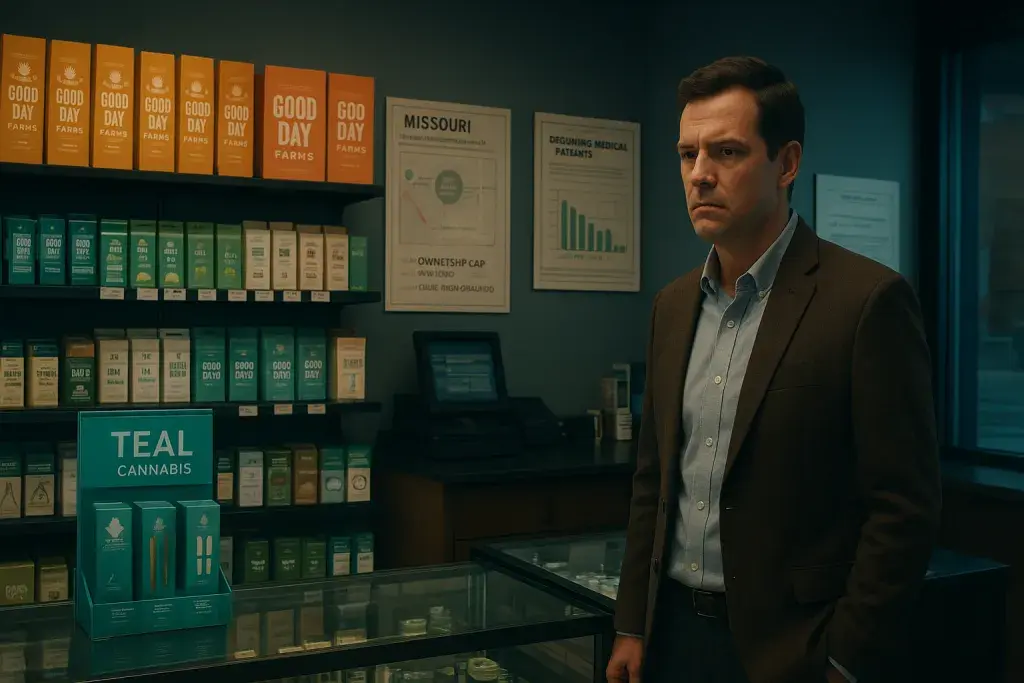
Adolphus Busch V left a working cannabis career in Colorado to build something in Missouri - his home state, a market he believed in, a $1.5 billion industry that looked, at the right angle, like an opening. What he found instead was a regulatory framework that started with defensible intentions and drifted, through a series of rule changes, into something that now favors operators with the deepest pockets and the most retail doors. His company, Teal Industries, is a useful case study in how licensing policy shapes - or distorts - market competition in a regulated cannabis state.
Teal manufactures pre-rolls, vape cartridges, disposables, and concentrates under the Teal Cannabis brand out of a facility in St. Peters, Missouri, and last year opened a single retail store in the St. Louis metro area under the Current Cannabis banner. That one-store footprint is both a symbol of Busch's ambition and the source of his most concrete market problem. For operators thinking through how compliance infrastructure, licensing structure, and wholesale access interact across regulated markets - the way a cannabis retail platform for New Jersey might approach shelf-space visibility and vendor relationships differently than a Missouri brand relying on wholesale distribution - Missouri's recent evolution offers a pointed warning about what happens when ownership rules are loosened without guardrails.
How Licensing Rules Opened a Door the State Didn't Mean to Open
Missouri's original medical cannabis framework had real structural logic. The state capped dispensaries at 230, manufacturing licenses at 86, and cultivation licenses at 60 - a limited-license model designed to prevent oversaturation and give licensees a reasonable shot at building a viable business. The 51% Missouri-resident ownership requirement added a local-capital dimension: the idea that proceeds from the state's cannabis market would, at least in part, stay in-state.
Both of those guardrails are now gone in meaningful ways. The residency requirement was dropped when adult-use legalization converted existing medical licenses to comprehensive licenses. Outside capital entered freely. And the 10% ownership cap on any single license type - which sounds like a hard ceiling - has a structural gap that sophisticated operators moved through almost immediately.
The mechanism matters. Companies can establish separate legal entities, each holding 10% of a given license type, stacking effective control well beyond what the cap was drafted to prevent. That's not a technical glitch - it's an ownership engineering problem, and it's now at the center of active litigation. A lawsuit filed in April by Vibe Cannabis and Local Cannabis Cos. alleges that Good Day Farms, Missouri's largest cannabis retailer, accumulated market share beyond what state law permits. The outcome of that case will have consequences far beyond the parties named in it.
Vertical Integration and the Shelf-Space Problem
Here's the catch for a brand like Teal: the licensing consolidation didn't just affect who owns what on paper. It changed how wholesale menus work in practice.
Large vertical operators controlling 10 to 20 stores cut supply and reciprocity agreements that effectively fill their own shelves with their own products. That's a rational business decision at the operator level. But for a manufacturing licensee with one retail door and a wholesale-dependent revenue model, the result is clear: fewer retail partners willing to carry independent brands, less shelf space, and in Busch's accounting, a potential eight-figure loss in revenue tied directly to displacement. "In a lot of cases, they just kind of forgot about us," he said.
One store doesn't generate the reciprocity leverage needed to access multi-store retail partners on favorable terms. That's not a complaint - it's an accurate description of how vertical integration functions in a limited-license state when ownership rules allow consolidation beyond their stated intent. The competitive distortion isn't hypothetical; it's showing up in wholesale pricing pressure, SKU displacement, and reduced distribution reach for independent brands across the state.
What Independent Operators Are Left to Work With
Busch's path forward is acquisition-driven: five stores by next year, ten by 2028, assembled through mergers with smaller operators facing refinancing pressure as cannabis-specific loans mature. License prices in Missouri haven't dropped below $5 million - so this isn't a budget strategy, it's a bet that distressed assets create a buying window that wouldn't otherwise exist at those prices.
He's skeptical of debt financing at current interest rates, and that skepticism is widely shared across the independent operator segment. The math on high-rate cannabis loans against compressed wholesale margins and shelf-space displacement is punishing. Debt doesn't fix a distribution problem.
Meanwhile, Missouri's medical patient counts are declining - a pattern visible across adult-use states where the cost differential between holding a medical card and buying retail has narrowed, and where purchase limits for adult-use customers now exceed what medical allotments allow in a 30-day window. Missouri patients are making the obvious calculation. That's a manageable trend for operators with scale and diversified revenue; for single-facility manufacturers dependent on medical wholesale, it's another compression point.
The broader implication for cannabis operators in any state watching ownership rule revisions move through their legislature: the licensing cap is only as strong as the entity structure rules that sit beneath it. Missouri wrote a cap without closing the workaround. Other states should look at that gap before they make the same move.