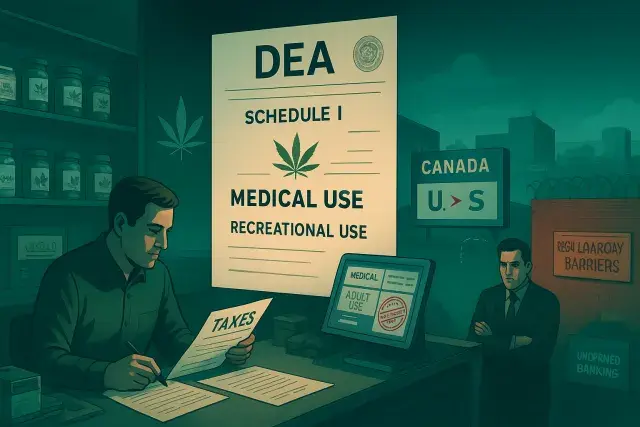
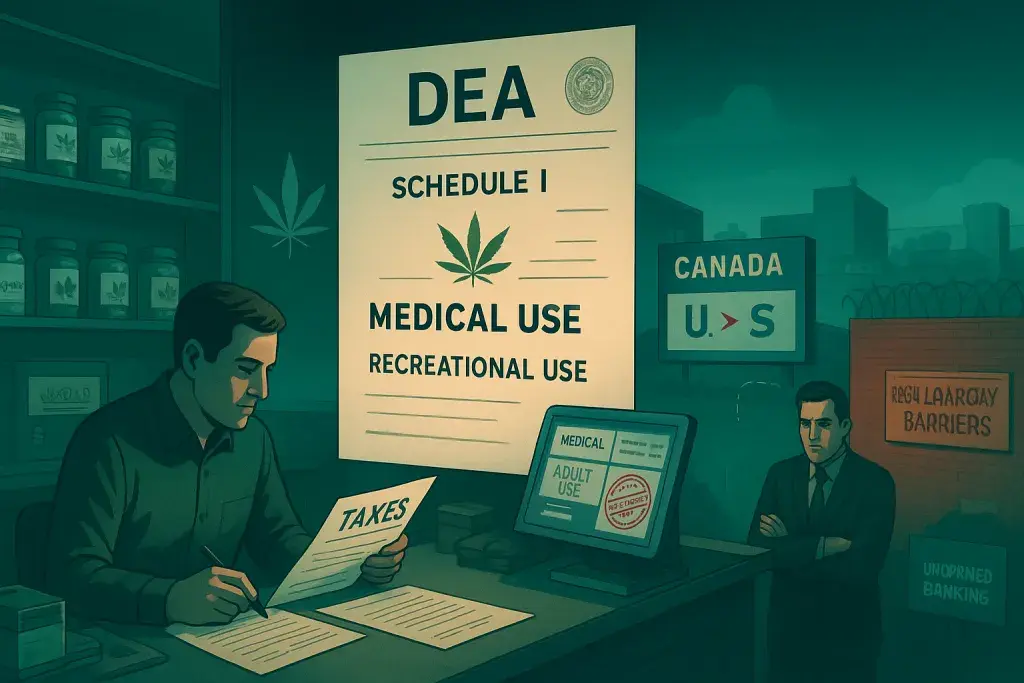
The Drug Enforcement Administration's move to reclassify marijuana from Schedule I to Schedule III marked the most significant federal cannabis policy shift in decades - at least on paper. In practice, though, the change is narrower than many in the industry anticipated, applying only to medical marijuana and leaving recreational cannabis untouched. For Canadian licensed producers with U.S. ambitions, the gap between what changed and what it actually means for their bottom line is considerable.
The operational machinery of U.S. cannabis retail has long adapted to a hostile federal environment. Dispensary operators - particularly those running multi-state medical programs - have built their entire financial architecture around 280E, the IRS provision that denied cannabis businesses the standard deductions available to virtually every other industry. Under Schedule I, a dispensary could only deduct cost of goods sold; rent, payroll, marketing, insurance, and most other ordinary business expenses remained non-deductible, effectively inflating taxable income well beyond actual profit. Rescheduling to Schedule III removes that restriction for qualifying medical cannabis sales, which is real relief for operators in medical-only or dual-use markets. Retailers and operators focused on medical compliance infrastructure - including those investing in cannabis pos systems california and elsewhere to cleanly separate medical from adult-use transactions - may find the accounting environment meaningfully improved. But the benefit flows to businesses that can clearly document and segregate medical sales, which puts a premium on accurate point-of-sale records and compliant inventory tracking.
For Canopy Growth, the calculus is murkier. The company holds a non-controlling interest in Canopy USA, the vehicle through which it maintains exposure to American cannabis assets, including medical-side operations. Because that interest is non-controlling, Canopy Growth cannot consolidate Canopy USA's financial results into its own. The practical consequence: any 280E relief flowing to Canopy USA's medical sales doesn't show up in Canopy Growth's reported financials in any direct way. The parent company remains at arm's length from the subsidiary's gains, however modest or meaningful those might be.
The Medical-Only Carve-Out Complicates Cross-Border Supply
There's another layer of friction specific to Canadian producers. Health Canada, the federal regulator overseeing cannabis in Canada, tightly controls export permits - limiting them to medical or research purposes. That's not an open channel to the U.S. medical market; it's a narrow corridor with regulatory gatekeepers on both sides. So the assumption that Canadian licensed producers can simply redirect product south under the new federal classification runs directly into export licensing constraints that haven't changed. The rescheduling didn't alter Health Canada's permitting framework, and it didn't create new pathways for bulk medical cannabis to cross the border at commercial scale.
This is the structural bind that makes the rescheduling feel, from a Canadian producer's vantage point, more symbolic than operational. The U.S. medical market is real and, in some states, substantial. But accessing it as a Canadian company requires either a compliant U.S. subsidiary - held at non-controlling arm's length, as in Canopy Growth's case - or a full legal restructuring that awaits more comprehensive federal reform. Neither the DEA's action nor any regulatory guidance issued alongside it resolved that structural question.
What the Reform Actually Changes - and for Whom
To be fair, the 280E relief is not trivial for certain businesses. A single-state medical dispensary that has been running a compressed margin structure partly because of non-deductible operating expenses - payroll for compliance staff, rent on a licensed retail facility, state licensing fees - stands to see a material improvement in its effective tax burden. That translates into real dollars. The relief is most direct for operators who are:
- Selling exclusively or primarily into the medical cannabis market
- Operating in states where medical programs are mature and well-regulated
- Able to cleanly document and separate medical sales from any adult-use activity in their POS and compliance logs
- Structured as U.S. domestic entities with direct federal tax exposure
That last point matters. The tax benefit is a U.S. domestic benefit, flowing through U.S. tax returns. Canadian corporations - even those with U.S. affiliates - don't receive it by proximity. They receive it only to the extent they control the entity filing U.S. taxes. Canopy Growth's current ownership structure, by design, keeps it from crossing that threshold.
The Longer View: Why Partial Reform Rarely Satisfies
The rescheduling has been described in some quarters as historic. And in a narrow technical sense, it is - no federal administration had reclassified marijuana in this direction before. But the cannabis industry, particularly its investment community, had priced in something more transformative. Full descheduling, or at minimum a reclassification that applied to adult-use commerce, would have opened banking access, resolved the broader 280E problem across recreational retail, and potentially cleared a path for conventional business financing. None of that happened.
Canopy Growth's situation illustrates how companies that built their U.S. strategy around the anticipation of broader reform are left holding a structure that was designed for a different outcome. The non-controlling interest in Canopy USA was a compliance workaround - a legal mechanism to maintain U.S. exposure without triggering Canadian stock exchange rules around U.S. cannabis ownership. It was always meant to be temporary, pending more complete legal change. That change hasn't come. The company has absorbed acquisitions, issued secondary shares that diluted earlier investors, and continued to post losses. The rescheduling, as structured, doesn't accelerate the path to consolidation.
For dispensary operators and licensed producers watching this space, the lesson is essentially this: partial reform relieves specific, bounded pressures - and the 280E shift for medical sales is genuinely one of them. But it doesn't restructure the underlying economics of an industry still operating without normal banking, still facing state-level tax burdens, and still segmented by state lines that federal law hasn't unified. The operators best positioned to benefit are those already embedded in the U.S. medical market, properly licensed, and structured to capture the tax change directly. For everyone else, the wait for something more substantial continues.