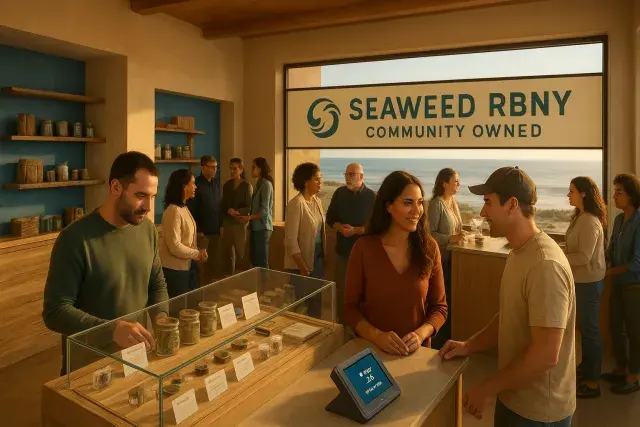
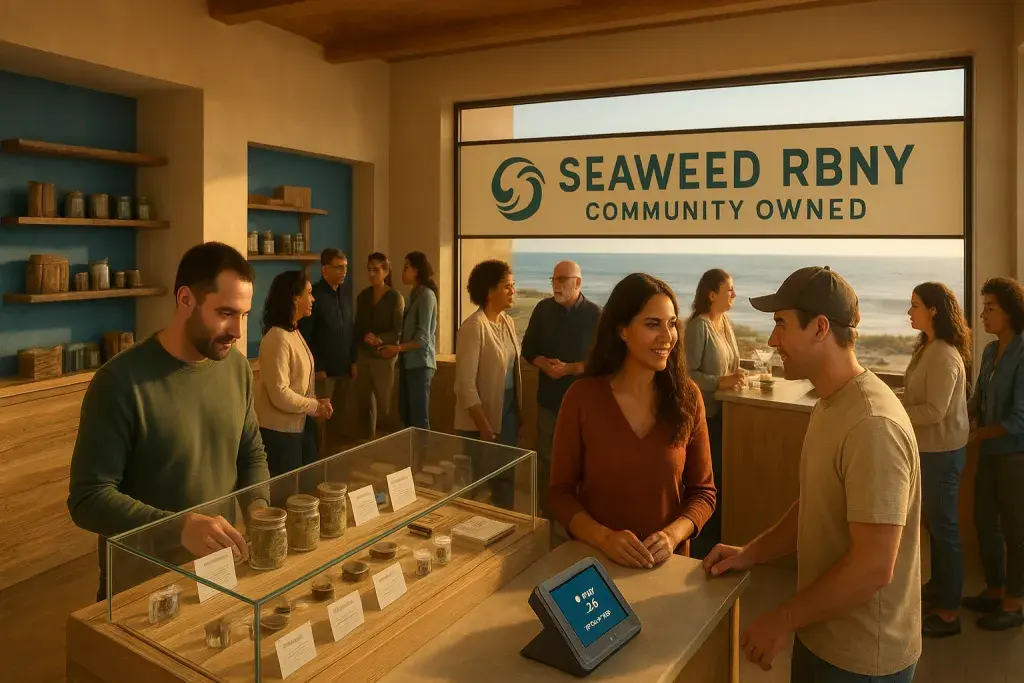
Seaweed RBNY opened in December 2025 at 73-13 Beach Channel Drive in Arverne, New York, positioning itself as Rockaway Beach's largest adult-use dispensary - but the more consequential detail is structural, not spatial. Forty community members hold equity stakes in the business, making it one of the most broadly community-owned licensed cannabis retail operations in New York State. In a market where outside capital has driven much of the dispensary build-out, that ownership model is worth examining closely.
Founder Adam Linet began laying groundwork in mid-2021, as New York moved toward legalizing adult-use cannabis. What followed was more than four years of coordination with the Office of Cannabis Management, licensing attorneys, architects, and contractors - the kind of long-cycle licensing process that filters out undercapitalized or underprepared operators before they ever open a door. That process is genuinely difficult to complete, and many aspiring New York operators have not. The operational discipline required to sustain a multi-year licensing effort correlates, in practice, with the discipline required to run a compliant retail floor. It is worth noting, for operators in other regulated states tracking how compliance infrastructure shapes retail culture, that tools like a Metrc-compliant POS for Missouri represent exactly the kind of back-end investment that separates operators who build durable businesses from those who struggle with seed-to-sale accountability when regulators come looking.
Linet and his wife Sam, along with co-founders Patti DiBart and Kevin Joyce, made a deliberate decision early in the process to open the venture to investment from neighbors, friends and family members - people already woven into the fabric of Rockaway life. Kevin Joyce, who serves as Treasurer, brings over 25 years of public accounting experience and 15 years as Executive Vice President at Citco Fund Services. That combination of neighborhood roots and institutional financial discipline is not accidental; it reflects a governance structure built to withstand the cash-flow pressures and compliance costs that have forced other New York dispensaries to close or restructure. The result: 40 community members hold an ownership stake in a single licensed retail location. By any measure, that is an unusually distributed cap table for a cannabis startup.
Brand Coherence as a Compliance and Retention Strategy
New York's adult-use regulatory framework places real constraints on how dispensaries can advertise, communicate, and present themselves in-store. Strict OCM rules around advertising, marketing claims, and consumer-facing language push many operators toward safe, generic presentations - compliant by necessity, but forgettable by design. Seaweed's founding team framed the compliance challenge and the brand challenge as the same problem: how do you build something legally sound that still earns genuine loyalty?
Their answer was to make brand coherence the differentiator. The store's interior - described by the founding team as "upscale coastal," with sandy tones, ocean blues, and open sightlines - was designed to mirror the experience customers encounter across Seaweed's website, app, and educational materials. That consistency between digital and physical touchpoints matters operationally, not just aesthetically. When customers move from an online product browse to an in-store conversation, a consistent brand register reduces the cognitive friction that can slow down a transaction or erode trust. In a retail environment where staff education is the primary compliance tool, a consistent voice across every channel makes that education easier to deliver and easier for customers to absorb.
Educational materials throughout the store explain product types, formats, and effects in plain language - no medical claims, no inflated potency language, no upsell pressure. That approach is compliant with OCM requirements and, incidentally, is also good retail practice. Customers who understand what they are buying are more likely to return. Customers who feel pressured or confused are not.
Inventory Curation and the Small-Producer Model
Seaweed carries flower, pre-rolls, edibles, cannabis beverages, vapes, concentrates, and topicals, sourced exclusively from licensed New York cultivators and producers. The curation approach, as Linet describes it, favors local cultivation, craft and small-batch growing practices, and transparency around sourcing. That is a deliberate SKU management philosophy, not just a marketing posture.
Carrying a rotating roster of smaller producers creates real inventory management complexity - shorter run sizes, less predictable wholesale availability, more frequent product introductions. It also creates a reason for repeat visits. Linet draws an explicit parallel to his other Rockaway business, Vino by the Sea, where championing boutique producers built a loyal following over time. The cannabis analog is structurally similar: customers who develop preferences for specific cultivators or terpene profiles become regulars in a way that commodity product selection rarely produces.
For operators and brands watching this model, the supply chain implication is clear. Dispensaries that prioritize craft and micro producers need wholesale partners who can communicate batch-level detail - cannabinoid and terpene data, certificates of analysis, cultivation practices - because that information is what staff need to have credible floor conversations. Without it, the educational retail model breaks down at the product level.
Loyalty Infrastructure and the Payments Problem
Seaweed operates the Poseidon Club, a loyalty program available through its branded app. Customers can browse inventory, place orders for in-store pickup or local delivery, and manage membership rewards in one place. Delivery is available within permitted areas across Rockaway Beach, Queens, and Nassau County. That delivery footprint extends the store's addressable market meaningfully beyond walk-in traffic.
Linet is direct about the friction still embedded in New York's cannabis retail environment. "I hope that some of the barriers that have been created with legislation, or the lack thereof, start to clear up," he says - specifically naming onerous advertising restrictions, clunky ecommerce infrastructure, and in-store payment limitations as ongoing operational headaches. That last point touches a pressure point felt across licensed cannabis retail nationally: the difficulty of offering customers a frictionless payment experience when federal banking restrictions continue to limit card processing options for cannabis businesses. Cashless ATM workarounds and cash-heavy operations carry compliance risk, shrinkage exposure, and real customer experience costs. It is one of the more concrete ways that the gap between cannabis retail and other regulated consumer retail - alcohol, for example - remains operationally visible every single day.
What Seaweed has built in Rockaway is a locally owned, community-capitalized dispensary with a coherent brand, a defined curation philosophy, and a leadership structure that takes compliance seriously. None of those things are guaranteed to produce a durable business on their own. But together, in a market still sorting out which operators have staying power, they form a more defensible position than most.